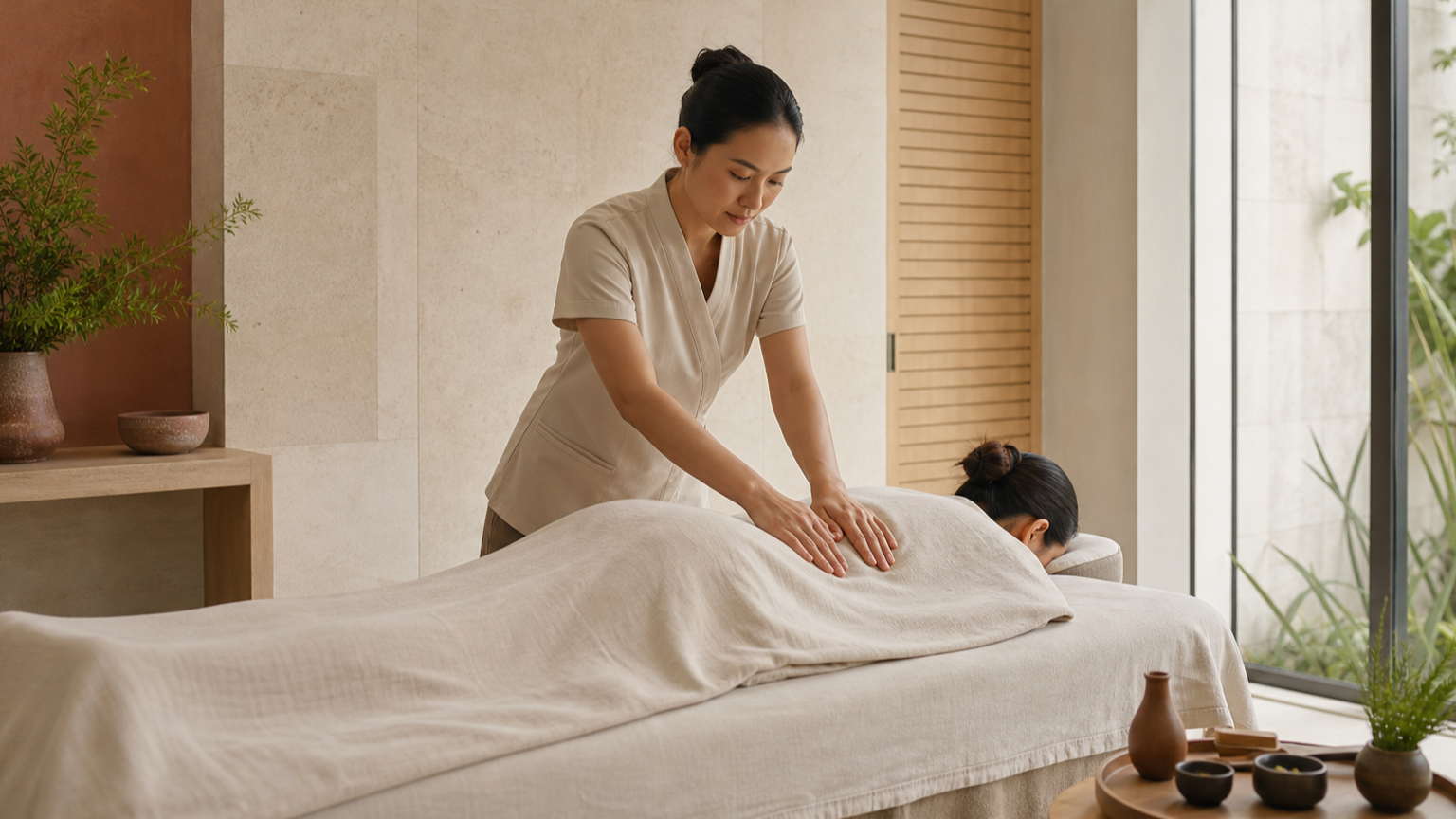
Myofascial release is easy to sell with vivid language. Menus promise to “break up adhesions”, “melt restrictions” or physically free fascia that has become stuck. Those explanations sound concrete, but a July 2026 systematic review challenges the mechanical story: across 25 controlled studies, massage techniques did not consistently change muscle, tendon or muscle–tendon-unit stiffness.
That does not make every myofascial-style session worthless. Separate research has reported short-term changes in range of motion or symptoms in particular groups. It does mean that spa operators should stop treating a disputed mechanism as a proven fact. The commercially stronger position is an accurately scoped manual-bodywork service, delivered by competent people, with careful screening, consent, pressure control and outcomes that can actually be measured.
This article sets out an evidence-led operating standard for non-clinical spas. It is not a treatment protocol or a substitute for medical, physiotherapy or legal advice. Its purpose is to help owners decide what they can responsibly offer, how to describe it and when a guest needs referral rather than a stronger sales promise.
What changed in the 2026 evidence
The Global Wellness Institute added a current myofascial release evidence summary to its Wellness Evidence platform in August 2026. It presents an appropriately mixed picture: some reviews report possible improvements in pain, function, flexibility or joint mobility, but study quality, methods and populations vary. The page also highlights an important new question—whether the technique physically changes tissue stiffness at all.
The underlying 2026 systematic review and meta-analysis searched five databases through January 2026. It included 25 studies with 617 participants: 17 examined self-massage, four manual massage and four instrument-assisted massage. The pooled analysis found no statistically significant change in overall muscle stiffness or gastrocnemius stiffness. The authors also found no consistent alteration in tendon or muscle–tendon-unit stiffness, while noting methodological heterogeneity.
A related 2026 review of manual and instrument-assisted myofascial release reached a similar conclusion with very-low-certainty evidence. Together, these findings weaken the familiar explanation that pressure mechanically softens, lengthens or “releases” tissue during a short session. They do not prove that no guest can feel looser or move differently afterwards; they show that a physical tissue-change story should not be presented as established mechanism.
There is evidence on functional outcomes, but it must stay attached to the population studied. A 2024 review of ten studies in athletes reported a moderate overall effect on joint range of motion compared with active or passive controls. That result cannot automatically be converted into a promise for older resort guests, people with chronic conditions or the general spa market. It supports a cautious testable objective—such as comfort during movement—not a universal therapeutic claim.
Separate outcome, mechanism and experience
Three different ideas are often collapsed into one menu sentence. The guest may report an experience such as warmth, ease or relaxation. A measured outcome may change, such as comfortable shoulder reach immediately after a session. A proposed mechanism attempts to explain why, for example altered pain perception, nervous-system modulation or a mechanical change in tissue.
A credible spa keeps those levels separate. A guest’s report is real as a report, but it is not proof that scar tissue was broken down. A change in range of motion is an outcome, but it does not identify the mechanism. A mechanism discussed in research should not become a guaranteed benefit in marketing copy.
Use a claims ladder
At the safest level, describe what the service is: slow, sustained manual pressure and gentle movement, adapted to comfort. Next, describe the intended non-clinical experience: relaxation, body awareness or a feeling of ease. If the team measures a short-term functional outcome, describe it only as an individual response. Avoid claims to diagnose fascia, correct structural dysfunction, remove toxins, cure pain, treat disease or permanently remodel tissue.
The US National Center for Complementary and Integrative Health advises consumers not to use massage to postpone medical care and to ask about therapist training and credentials. Its current massage evidence and safety summary also notes that serious adverse effects are rare but have occurred, particularly with vigorous massage or people at increased risk of injury. That is a useful reminder: “natural” and “hands-on” do not mean risk-free.
Define the service before naming it
An operator should write a one-sentence scope statement before writing the menu. For example: “A non-clinical manual-bodywork session using slow, comfortable pressure and guided movement to support relaxation and explore short-term ease of movement.” The words matter. “Explore” leaves room for individual response; “restore” or “correct” implies a predictable result.
Decide whether myofascial release is a standalone service, a technique within a massage or a clinician-led intervention. These are not interchangeable. A spa therapist can remain within a defined wellness scope. A licensed health professional may have a different assessment and treatment scope. The property must not blur those roles because a shared technique name appears in both settings.
In Thailand, the Department of Health Service Support publishes the legal framework for health establishments and provider registration. The official ministerial standards for spa and massage establishments require safety, service controls and attention to guests whose age or health condition may create risk. They also state that services must not violate laws governing medical and health professions. Operators should verify the current Thai requirements and any other jurisdiction that applies to their property, team and claims.
Build a readiness and referral route
A spa consultation should identify whether the planned service fits the guest today; it should not attempt to diagnose the source of pain. Use a short, documented route with plain-language questions about the guest’s goal, current symptoms, recent injury or procedure, skin condition, medication relevant to bruising or sensation, and any professional advice already received.
The route needs three outcomes. Proceed means the information fits the defined service. Modify means the therapist adjusts position, area, pressure or duration. Refer or decline means the session falls outside the spa’s scope or the team cannot establish that it is appropriate. The escalation owner should be named before the first booking.
Examples that warrant caution or referral include unexplained acute or worsening pain, suspected fracture, new neurological symptoms, fever or systemic illness, open wounds, active infection, recent surgery without clearance, known or suspected blood clot, or a guest seeking treatment for a condition the spa is not qualified to manage. This is not a diagnostic checklist. It is a stop-and-refer discipline that prevents front-desk confidence from outrunning professional authority.
Make consent continuous
Consent is not a signature collected once. Explain the area, draping, position and technique before touch. Agree on a simple pressure scale or comfort language. Check in after a position or pressure change, and make stopping or changing the session normal. A guest should never feel that enduring pain proves the technique is working.
The wider science of touch in massage is a useful context for communication and comfort, but it does not justify turning every sensation into evidence of tissue correction.
Standardise delivery without pretending there is one protocol
The research literature uses different manual, instrument-assisted and self-release methods. Durations, body areas, pressure, comparison groups and outcomes vary. A spa should therefore avoid claiming that its branded sequence is “the research-backed protocol” unless the exact protocol and population have actually been studied.
Instead, standardise the controllable parts of service quality. Record the scope statement, consultation route, positioning and draping options, pressure communication, areas requiring additional permission, stop criteria, hygiene, post-session advice and incident reporting. Give therapists boundaries within which they can adapt to the individual.
The room should support safe body mechanics for both people: an adjustable or suitable-height table, stable access around it, clean linens, good lighting for setup, and no obstacle that forces awkward leverage. The five-star treatment-room checklist helps connect premium presentation with practical safety and repeatability.
Avoid pain theatre
Some marketing celebrates grimacing, extreme pressure or visible redness as proof of effectiveness. That is poor evidence and a weak service standard. Pressure should be purposeful, agreed and adjustable. Bruising, sharp pain, numbness, dizziness or distress are not badges of a successful release.
Tools add another decision layer. If a service uses balls, rollers, scraping tools or percussion devices, document cleaning, inspection, contraindications, therapist competence and device instructions. Do not assume that adding equipment makes the result more scientific.
Train for judgment, not choreography alone
A therapist can memorise a sequence and still be unprepared to decide when not to use it. Competency assessment should cover relevant anatomy, the limits of mechanism claims, consultation, referral, consent, draping, pressure adaptation, therapist body mechanics, incident response and documentation. Observation on a model should test communication as well as hand placement.
Managers should verify the registration, qualification and scope required in the operating jurisdiction. A weekend certificate may show attendance; it does not automatically establish competence, legal authority or the ability to work with clinical populations. The site’s existing guidance on training and retaining quality spa therapists provides a useful foundation for supervised practice, feedback and continuing development.
Use a sign-off process. First, the therapist explains the service and evidence boundary. Second, they complete a consultation scenario containing a referral trigger. Third, they demonstrate positioning, pressure communication and adaptation. Fourth, they document the session accurately. Reassess after a defined number of services, an incident, a complaint or a material change in the technique.
Measure what a spa can honestly know
Do not ask whether the session “released fascia”; the property has no routine way to establish that. Choose outcomes tied to the guest’s goal and the service window. A pre- and post-session comfort rating, a simple comfortable movement chosen in advance, perceived pressure, goal attainment and next-day follow-up for adverse effects are more defensible.
Aggregate operational measures can include consultation completion, modification and referral rates, consent or pressure-related complaints, adverse events, repeat booking, therapist-reported strain and documentation quality. Review negative and neutral responses, not only testimonials. A service that feels excellent to half the guests and too intense to the other half needs a better standard, not stronger copy.
Do not convert immediate change into a lasting claim. If shoulder reach improves directly after a session, record exactly that. It does not prove permanent structural change or future pain relief. If the business wants to make clinical outcome claims, it needs appropriate research design, professional oversight, validated measures and ethical governance.
Write a menu that can survive scrutiny
A responsible menu explains the method, duration, intended experience and limits in ordinary language. One example is: “A slow, pressure-led bodywork session tailored to comfort, with gentle movement where appropriate. Designed for relaxation and short-term ease of movement; it is not a diagnostic or medical treatment.”
Avoid anatomical certainty that the therapist cannot verify. “Targets fascial restrictions detected during assessment” sounds clinical and suggests a reliable diagnostic method. “Uses slow sustained pressure around areas the guest identifies as tense” is more transparent. Do not advertise detoxification, scar-tissue removal, injury repair or guaranteed pain relief.
The name also affects expectation. If “myofascial release” is likely to be interpreted as medical treatment in the market, a descriptive name such as “slow-pressure mobility bodywork” may be safer and clearer. Have local legal and professional advisers review the final menu, booking page, consultation form and staff script together.
A 90-day implementation plan
Days 1–30: scope and evidence
Choose the intended guest and write the one-sentence scope. Map the current evidence, prohibited claims, legal category, practitioner requirements and referral partners. Decide whether the service is new or a technique within an existing massage. Draft the consultation route and menu copy before buying equipment or training a large team.
Days 31–60: competency and rehearsal
Train a small cohort. Use observed practice, referral scenarios and documentation review rather than attendance alone. Test room setup, draping, pressure language and escalation. Ask people who did not design the service to read the menu and explain what they think it promises; revise any phrase that implies diagnosis or guaranteed structural change.
Days 61–90: capped pilot
Limit therapists, dates and bookings. Review every modification, referral, complaint and adverse response. Compare the guest’s stated goal with the measured outcome and check next-day tolerability. At the end of the pilot, decide whether to continue, revise or stop based on safety, clarity, therapist confidence and repeatable service quality—not novelty or social-media response.
Conclusion: credibility is the premium position
Myofascial release offers a useful test of evidence-led spa management. A guest can value slow manual work without the operator claiming to physically remodel fascia. A short-term movement change can be recorded without becoming a cure. A technique can be popular while its mechanism remains uncertain.
The best standard is therefore practical: define a non-clinical scope, remove unsupported mechanical claims, screen and refer, make consent continuous, verify therapist competence and measure outcomes the property can actually observe. That approach protects guests and staff while giving the service a clearer commercial identity.
In a crowded menu, credibility is not timid. It is a premium signal that the operator understands both the appeal and the limits of the work.
Practical quality check for Myofascial Release in Spas: An Evidence-Led Standard
People topics only matter when they change daily behavior. For this article, the test is simple: can a spa owner read "Myofascial Release in Spas: An Evidence-Led Standard" and know what to check, what to improve and what result should change in the business? If the answer is vague, the topic needs to be translated into a concrete operating decision, not left as a broad marketing idea.
Use this topic as a short management review. Compare the current guest journey with the promise in the title, then look for gaps in training records, service observations, therapist confidence and guest feedback. The strongest version of the article is the one that connects the idea to real rooms, real staff behavior, real booking steps and real follow-up after the visit.
Owner checklist
- Define the decision: write what the owner, manager or front desk should change after reading about Myofascial Release in Spas: An Evidence-Led Standard.
- Check the evidence: collect the page, listing, menu, script, photo, review or operating report that proves the current situation.
- Protect the guest experience: make sure the change improves clarity, comfort, trust, timing or consistency for the client.
- Choose one measure: review booking accuracy, staff adoption, data completeness and time saved per workflow so the team can tell whether the improvement worked.
How NUAD SPA would apply it
NUAD SPA would treat Myofascial Release in Spas: An Evidence-Led Standard as a focused workstream, not an isolated article topic. The first step is to map the current process, then decide whether the main blocker is positioning, service design, team execution, digital visibility, booking friction or retention. That diagnosis keeps the recommendation close to the title and avoids generic advice.
The next step is a two-week action sprint: update one public-facing touchpoint, brief the team on the new standard, test the booking or service flow, and collect feedback from staff and guests. This makes the article useful because it creates a next move, not only a point of view.
Risks to avoid
The common mistake is to make Myofascial Release in Spas: An Evidence-Led Standard sound bigger than the spa can operationally support. A campaign can create demand the reception cannot answer; a new treatment can promise benefits the team has not been trained to deliver; a design trend can look attractive but reduce flow or profitability. The safer approach is to pair every idea with an owner, a checklist and a visible standard.
Frequently asked questions
Does myofascial release physically loosen or soften fascia?
Current review evidence does not establish that short manual or instrument-assisted sessions reduce muscle, tendon or fascial stiffness. Guests may report comfort or show a short-term movement change, but operators should not present mechanical tissue release as a proven explanation.
Can a non-clinical spa offer myofascial release?
That depends on the service scope, practitioner qualifications, claims and law where the spa operates. In a non-clinical setting, define it as adapted manual bodywork rather than diagnosis or treatment, verify local requirements and maintain a clear referral route.
What should a spa screen before a session?
Ask only what is needed to judge readiness: the guest’s goal, current symptoms, recent injury or procedure, relevant health risks and professional advice already received. Acute or worsening unexplained symptoms, possible clot, fracture, infection, neurological change or recent surgery may require referral or clearance.
Should myofascial release hurt to work?
No. Pain is not proof of release. Pressure should be agreed, adjustable and stopped when it produces sharp pain, numbness, dizziness, distress or another concerning response. Continuous consent and clear pressure communication belong in the service standard.
How should a spa measure results?
Use goals and observations the spa can defend: comfort, a preselected comfortable movement, pressure tolerance, satisfaction, next-day adverse effects, modifications, referrals and complaints. Record the timing and do not turn an immediate change into a permanent or clinical claim.
Sources and references
- Global Wellness Institute — Myofascial Release evidence summary
- PubMed — Short-term effectiveness of massage techniques on myotendinous stiffness
- PubMed — Myofascial release and joint range of motion in athletes
- US National Center for Complementary and Integrative Health — Massage Therapy: What You Need To Know
- Thailand Department of Health Service Support — Ministerial standards for spa and massage establishments
Need to turn this diagnosis into an action plan? Talk to NUAD SPA.