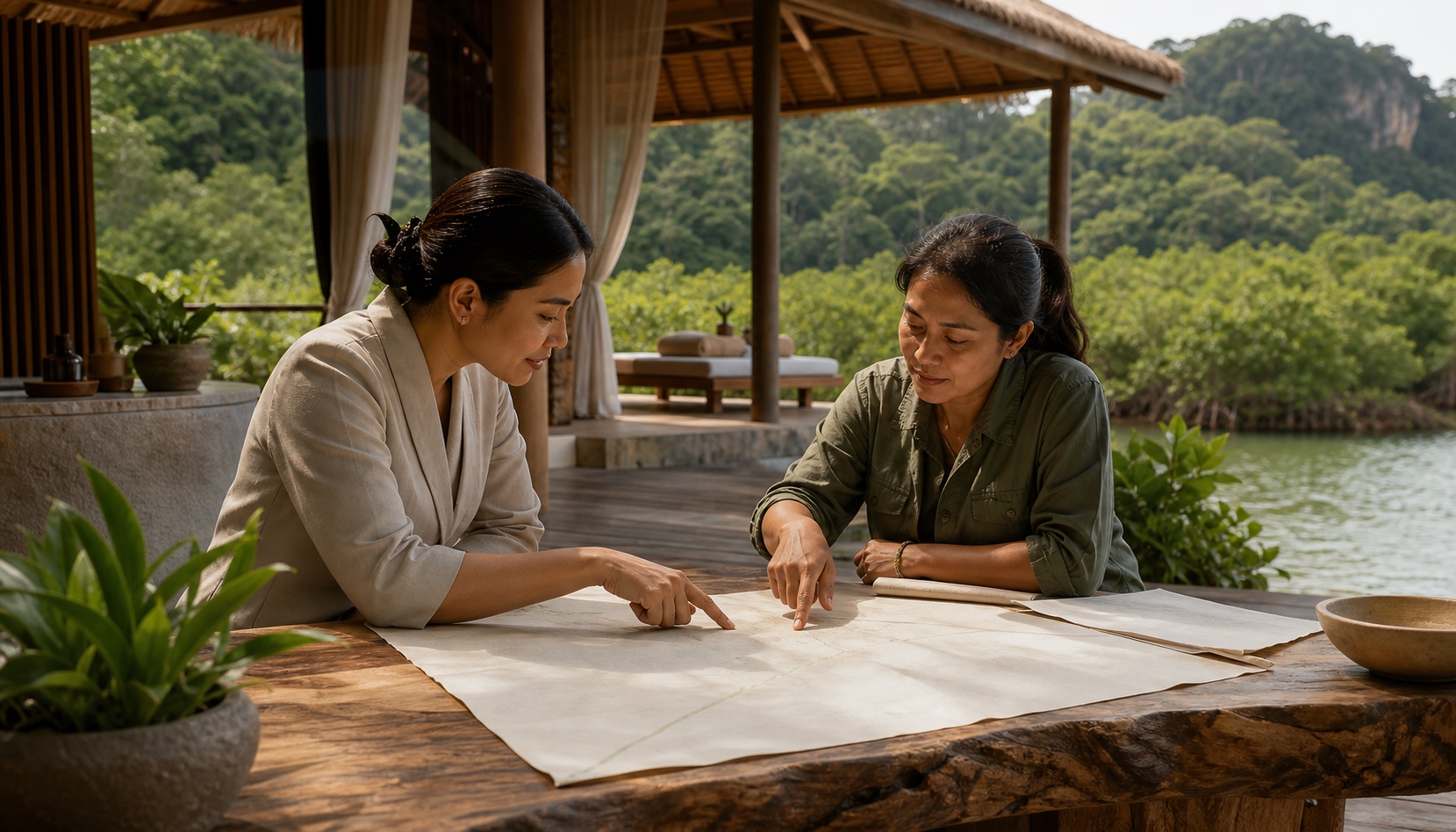
A new kind of resort programme is joining spa ritual with conservation activity. Gaya Island Resort in Malaysian Borneo is marketing an inaugural three-day Wellness & Wonder Journey for 17–19 September 2027, curated by its conservation and spa teams. The offer brings wildlife observation, coral planting and local healing traditions into one itinerary. It is a useful signal for operators, but not a template to copy without scrutiny.
Nature can enrich a wellness experience, yet it is not scenery that a spa owns. A forest, reef, mangrove or wildlife population has ecological limits, legal protections and local stakeholders. Adding meditation to an excursion does not make it responsible. A credible nature-positive programme must first avoid harm, then contribute to conservation and community priorities, and finally show evidence for the claims made about it.
This guide translates that principle into a practical operating model for spas, hotels and retreats. It does not claim that a short nature activity produces a particular health outcome. Its focus is the work an operator can control: governance, programme design, wildlife boundaries, accessibility, staff competence, guest communication, partner due diligence and measurement.
Why nature-linked wellness needs a stronger operating standard
The commercial idea is attractive. A spa can connect treatment, movement, rest and place rather than selling each component separately. A resort can also distinguish its programme through the real ecology and culture of its destination. However, the same combination creates risks that ordinary treatment-menu planning may miss.
Nature activities can disturb habitat, change animal behaviour, increase pressure on sensitive sites or turn a conservation action into a photo opportunity. Cultural material can be simplified or used without meaningful local participation. Marketing teams may describe a package as regenerative or transformative before the operator has defined what changed, for whom, and how that change was measured.
The current GSTC Hotel Standard v4.01, dated 30 December 2025, offers a useful baseline. It asks hotels to manage sustainability systematically, make promotional claims accurate and verifiable, engage local stakeholders, support biodiversity, prevent invasive species and set firm boundaries around wildlife interaction. Its standard is deliberately broader than a spa programme, but the logic transfers well.
Define “nature-positive” before putting it on the menu
There is no honest shortcut from “outdoors” to “nature-positive”. An outdoor yoga class may have a low impact, a neutral impact or a damaging impact depending on its location, timing, group size, sound, lighting, waste and access route. A coral activity may be valuable when designed and supervised by qualified local conservation practitioners, or harmful when improvised as guest entertainment.
For an operator, a workable definition has three levels:
First, avoid and reduce harm
Respect permits, closures, carrying limits, wildlife distances, quiet periods and local codes. Keep guests away from nesting, feeding and rehabilitation areas unless competent authorities and conservation partners explicitly approve access. Review noise, artificial light, transport, waste, chemicals and water use. “Leave no trace” is a minimum behaviour, not proof of a positive contribution.
Second, support an identified local priority
The contribution should answer a need defined with a credible conservation or community partner. It might fund habitat monitoring, trained local guides, restoration materials or environmental education. The operator should know where money and staff time go, who is responsible, and whether the activity continues when guest demand is low.
Third, document outcomes without exaggeration
Record inputs and results that can actually be verified. Number of trained guides, partner hours funded, restoration plots maintained, guest briefings completed and incidents logged are more defensible than vague claims about “healing the planet”. If the ecological result will take years to assess, say so. Do not convert participation into an outcome that the data cannot support.
This extends the site's earlier guidance on making spa sustainability operational. The new distinction is that a nature-linked product affects a living destination beyond the treatment room.
Build the programme with three owners, not one
A credible programme needs at least three accountable perspectives from the start.
The spa or wellness lead
This person defines the guest journey, treatment suitability, pace, recovery time, therapist workload and service standards. They also separate hospitality language from medical claims. A programme can promise a carefully hosted experience; it should not promise treatment of stress, immunity, trauma or disease without appropriate clinical evidence and authority.
The conservation lead
This should be a qualified internal specialist or an independent local partner with relevant field knowledge. The role is not decorative. It sets site limits, timing, group size, visitor behaviour, monitoring and stop conditions. It also decides when a proposed activity should not run.
The community or cultural rights-holder
If local knowledge, language, rituals, plants, craft or stories enter the programme, the people connected to that heritage need a real role. Agree consent, interpretation, payment, attribution and intellectual-property boundaries. A spa manager should not turn cultural material into a signature ritual through aesthetic inspiration alone.
The Convention on Biological Diversity’s tourism guidelines reinforce this process-led approach: establish baseline information, set goals, assess impact, manage and mitigate it, monitor results and adapt. Those stages are valuable because they make the programme reviewable before it becomes a campaign.
Use a programme architecture that protects the site
A nature-positive experience is better designed as a sequence of controlled moments than as a list of attractions.
Before arrival
Give guests an accurate description of terrain, heat, humidity, boat travel, insects, physical effort, accessibility, clothing and prohibited behaviour. State that wildlife sightings are never guaranteed. Explain whether conservation activity depends on weather, tides, permits or specialist availability. Offer a dignified alternative rather than pressuring every guest to participate.
At the briefing
Confirm group size, route, emergency contacts and the guide’s authority to change or cancel the activity. Explain photography rules and why feeding, touching, chasing or close-up positioning are not part of the experience. The GSTC standard is especially clear for directly managed environments: close contact with wild animals, including feeding, touching, holding and staged close-up photographs, should be prohibited.
In the field
Keep the conservation specialist in operational control. The spa host supports pacing and guest care but does not override ecological limits. Use designated access routes, quiet observation, appropriate distance and small groups. If a restoration activity is included, participants should perform only the tasks the partner has designed for visitors.
Back at the spa
Allow recovery time before treatment. Check hydration and comfort, and apply the spa’s normal consultation and contraindication process. A treatment can interpret the place through verified local ingredients, craft or story only when sourcing, safety, consent and attribution are sound. It should not claim to reproduce an Indigenous healing practice merely because the aesthetic is local.
Treat wildlife encounters as a controlled exception
Wildlife is often the strongest marketing image and the greatest operating risk. A responsible programme does not promise a sighting, create contact, lure animals or move guests closer for content. It does not use rehabilitation work as a backdrop unless the responsible specialists consider public access appropriate.
Gaya Island Resort describes its property as part of Tunku Abdul Rahman Marine Park and says its wildlife and marine centres work on habitat protection, animal rehabilitation, coral restoration and education. Its current special-offer page schedules the inaugural Wellness & Wonder Journey for September 2027. These pages provide a primary-source example of how one resort is presenting the model; they are not independent proof of ecological outcomes.
That distinction belongs in the editorial process. Operators may describe the programme, partners, date and documented activities. They should avoid turning their own promotional statements into evidence that a population, reef or habitat improved.
Design for access without lowering ecological safeguards
Nature programming can unintentionally exclude guests who cannot manage boats, steep trails, heat, low light or long periods of standing. Accessibility should be considered during product design, not handled as an exception at check-in.
Create equivalent ways to engage: a seated naturalist briefing, accessible observation point, conservation talk, sensory interpretation, live remote field update or spa-based reflection led by the same partner. Publish practical access information and let guests choose without disclosing more personal information than necessary. This is where lessons from responsible retreat planning remain useful: the itinerary must work as an operating system, not just a brochure.
Make the economics transparent to the operating team
A positive-sounding programme can fail if the conservation contribution disappears when occupancy falls or if guides are treated as an optional cost. Build a simple programme-level contribution statement.
Track guest revenue separately from the amount allocated to the conservation or community partner. Record guide fees, transport, permits, monitoring, equipment, insurance, staff preparation and recovery time. Decide whether the contribution is a fixed amount per departure, a share of revenue or a minimum annual commitment. A fixed floor can protect the partnership from seasonal volatility, while a per-guest amount makes the mechanism easy to explain.
Do not label the entire package price as a conservation contribution. State the exact mechanism internally and, if communicated publicly, use language that finance and the partner can verify.
Measure a small set of defensible indicators
The dashboard should cover pressure, participation, contribution, quality and corrective action.
Environmental pressure
Track departures, group size, route or zone, cancellations caused by site limits, transport mode, waste removed, water use where relevant, and any disturbance or rule breach. For carbon boundaries, the site's guide to measuring carbon per spa visit explains why denominators and operational boundaries need to be defined before comparisons are made.
Partnership and contribution
Record money transferred, in-kind hours, locally contracted guide hours, training completed and the partner-defined activity supported. Ask the partner to confirm the record. Do not create an ecological impact metric without their technical input.
Guest and team quality
Measure briefing completion, guest understanding of behaviour rules, accessibility requests met, complaints, near misses and staff confidence. A short post-experience question about what guests learned can be more useful than asking only whether they enjoyed it.
Corrective action
Log what changed after an incident, partner concern, seasonal condition or negative observation. A nature-positive programme is credible when it can slow down, relocate or stop. Continuous expansion is not the only sign of success.
A 90-day path from idea to controlled pilot
Days 1–30: establish permission and baseline
Identify the relevant authority, conservation partner and community stakeholders. Map the proposed site, season, species, access, transport and legal requirements. Document current conditions and known sensitivities. Agree what the spa may and may not say.
Days 31–60: design and test the operating system
Write the itinerary, briefing, guest information, accessibility alternatives, staff roles, cancellation rules and emergency contacts. Test the route with the conservation lead and a small internal group. Review timing against treatment-room schedules and staff workload. Prepare the measurement sheet before selling the programme.
Days 61–90: run a limited pilot
Cap departures and group size. Collect operational data and partner feedback after every session. Review marketing copy against what actually happened. At the end of the pilot, decide whether to continue, redesign, pause or stop. Expansion should require evidence that safeguards worked and the partner still supports the model.
Conclusion: the place is a stakeholder
The best nature-linked spa programmes do not use conservation as decoration. They give ecological expertise decision-making power, compensate local participation, set visible limits and publish only what their records support.
Gaya Island Resort’s announced 2027 itinerary shows why this format is likely to attract attention: it connects spa, wildlife, restoration and destination identity in one experience. The durable lesson is not to copy its activities. It is to build a governance system suited to the specific habitat, community, laws and capabilities of each property.
For operators, nature-positive design begins before the first guest arrives and continues after the last photograph is taken. The programme earns credibility through what it protects, what it contributes, what it can prove and what it is willing not to do.
Practical quality check for Nature-Positive Spa Experiences: An Operator Playbook
Digital topics are valuable when they remove friction from the guest journey and the team workflow. For this article, the test is simple: can a spa owner read "Nature-Positive Spa Experiences: An Operator Playbook" and know what to check, what to improve and what result should change in the business? If the answer is vague, the topic needs to be translated into a concrete operating decision, not left as a broad marketing idea.
Use this topic as a short management review. Compare the current guest journey with the promise in the title, then look for gaps in booking data, response quality, system adoption, page clarity and operational handoffs. The strongest version of the article is the one that connects the idea to real rooms, real staff behavior, real booking steps and real follow-up after the visit.
Owner checklist
- Define the decision: write what the owner, manager or front desk should change after reading about Nature-Positive Spa Experiences: An Operator Playbook.
- Check the evidence: collect the page, listing, menu, script, photo, review or operating report that proves the current situation.
- Protect the guest experience: make sure the change improves clarity, comfort, trust, timing or consistency for the client.
- Choose one measure: review booking accuracy, staff adoption, data completeness and time saved per workflow so the team can tell whether the improvement worked.
How NUAD SPA would apply it
NUAD SPA would treat Nature-Positive Spa Experiences: An Operator Playbook as a focused workstream, not an isolated article topic. The first step is to map the current process, then decide whether the main blocker is positioning, service design, team execution, digital visibility, booking friction or retention. That diagnosis keeps the recommendation close to the title and avoids generic advice.
The next step is a two-week action sprint: update one public-facing touchpoint, brief the team on the new standard, test the booking or service flow, and collect feedback from staff and guests. This makes the article useful because it creates a next move, not only a point of view.
Risks to avoid
The common mistake is to make Nature-Positive Spa Experiences: An Operator Playbook sound bigger than the spa can operationally support. A campaign can create demand the reception cannot answer; a new treatment can promise benefits the team has not been trained to deliver; a design trend can look attractive but reduce flow or profitability. The safer approach is to pair every idea with an owner, a checklist and a visible standard.
Frequently asked questions
What makes a spa experience nature-positive?
It should first avoid and reduce harm, then support a locally identified conservation or community priority, and document its contribution without overstating ecological or health outcomes. Outdoor scenery alone is not enough.
Can a spa include wildlife viewing in a wellness package?
Yes, when the activity complies with local rules and is designed and controlled by qualified wildlife or conservation specialists. It should use non-invasive observation, avoid guaranteed sightings and prohibit feeding, touching, holding or staging close-up photographs with wild animals.
How should a conservation contribution be priced?
Agree the mechanism with the partner. Options include a fixed amount per departure, a stated share of programme revenue or a minimum annual commitment. Record the transfer separately from general package revenue and never imply that the full price funds conservation.
What should a nature-linked spa programme measure?
Track group size, site pressure, rule breaches, partner payments, local guide hours, training, briefing completion, accessibility needs met, incidents, guest learning and corrective actions. Ecological outcome measures should be defined with qualified local experts.
Should a programme promise health benefits from time in nature?
No specific medical or therapeutic outcome should be promised without appropriate evidence and authority. Operators can accurately describe the itinerary, setting and hosted experience while keeping clinical claims out of spa marketing.
Sources and references
- Gaya Island Resort — Special Offers: The Gaya Wellness & Wonder Journey
- Gaya Island Resort — Resort Facilities, Wildlife Centre and Marine Centre
- Global Sustainable Tourism Council — GSTC Hotel Standard v4.01
- Convention on Biological Diversity — Guidelines on Biodiversity and Tourism Development
Need to turn this diagnosis into an action plan? Talk to NUAD SPA.