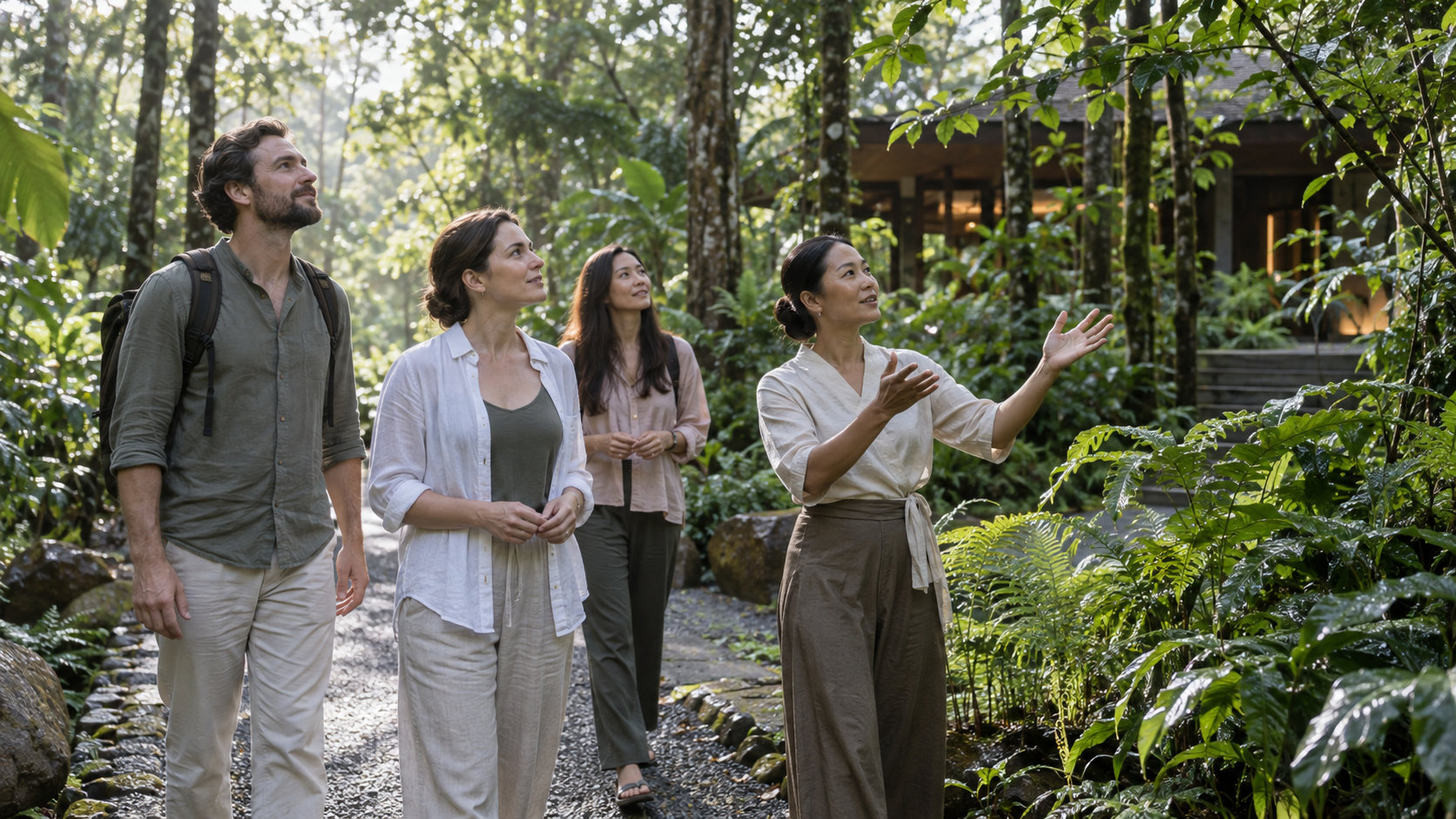
Forest bathing can look deceptively simple: take guests into a green setting, slow the pace and invite them to notice what is around them. For a spa or resort, however, a credible programme is not created by adding a woodland walk to the menu. It is a designed service that needs a suitable place, a competent facilitator, clear guest information, weather and access plans, careful claims, and a method for learning whether the experience works operationally.
Fresh evidence makes that distinction timely. A Thai qualitative study published on 30 September 2026 examined how 16 founders and executives approach forest-bathing accommodation businesses. A separate 2026 resort field study record describes guidance, attention and guest participation as parts of the service rather than assuming that the forest alone creates value. Neither study proves a universal health effect. Together, they offer a useful management lesson: nature is the setting, but service quality comes from how an operator prepares, hosts, adapts and reviews the encounter.
Key takeaways
- Define forest bathing as a slow, sensory, non-competitive hosted experience, not a hike, treatment or guaranteed health outcome.
- Choose a route through a documented assessment of terrain, weather, access, heat, insects, wildlife, emergency response and ecological limits.
- Train facilitators to manage attention, consent, group dynamics and stop conditions without drifting into diagnosis or therapy claims.
- Offer meaningful choices for pace, silence, participation and accessibility so guests can engage without pressure.
- Measure delivery quality, incidents, inclusion and guest understanding before using satisfaction or commercial results to support expansion.
Start with the service definition, not the marketing name
Japan's Forestry Agency says the idea of shinrin-yoku was proposed in 1982 as an accessible way to become familiar with forests, using the atmosphere of the forest and the senses. That history matters because it places attention and contact with the setting at the centre. It does not make every walk through trees a professional forest-bathing service.
An operator should write a one-sentence definition before developing the itinerary. A practical version is: “A guided, slow-paced sensory experience in a suitable natural setting, designed for attentive participation and hospitality comfort rather than distance, fitness performance or clinical treatment.” That sentence sets boundaries for sales, staffing and guest expectations.
The Thai study in the Journal of Business, Innovation and Sustainability is especially relevant to local operators. Its interviews with 16 founders and executives describe forest bathing as a service and business-design question, with people, process and community relationships among the strategic considerations. The sample is qualitative and cannot represent every Thai property. Its value is in identifying operating themes to test, not in supplying a ready-made formula.
That service definition also distinguishes the offer from the site's existing guide to nature-positive spa experiences. Nature-positive governance asks what a programme protects and contributes to the destination. Forest-bathing service design asks how a specific guided encounter is prepared, facilitated and evaluated. A responsible operator needs both perspectives, but they solve different problems.
Translate the evidence without turning it into a promise
The evidence base is promising but uneven. The World Health Organization's review of green and blue spaces and mental health reports an overall positive relationship, while also warning that research does not identify one “gold standard” type of space that works for everyone, everywhere and at all times. That is an important constraint for spa copywriters.
A 2026 field study of a three-day guided programme in a four- to five-star coastal resort found higher immediate post-programme scores across study-specific experiential domains. Yet the study had no control group. Its authors explicitly state that the differences cannot be assigned to forest bathing alone rather than the wider resort stay, time away from routine, recreation, social interaction, expectations or repeated measurement. The responsible editorial conclusion is therefore about testable service choices—onboarding, facilitation and evaluation—not a guaranteed therapeutic result.
The Japan Forestry Agency's official explanation describes forest bathing as receiving the forest atmosphere through the senses and says the term was proposed in 1982 as an accessible way to become familiar with forests. A spa can accurately explain those features and origins. It should not convert an official cultural description or a limited field study into a promise to treat stress, anxiety, blood pressure, immunity or any other condition.
Claims discipline is not a reason to make the offer vague. Describe what the guest will actually do, where it happens, how long it lasts, who leads it, the likely terrain, the group size and the choices available. If a property combines the activity with assessment, devices or clinical services, the governance requirements become materially different; the site's wellness medical screening guide explains that stronger boundary.
Design an itinerary around attention and choice
A credible session has an arc. It does not need theatrical ritual, but it does need a beginning, a managed middle and a clear return.
Before the session
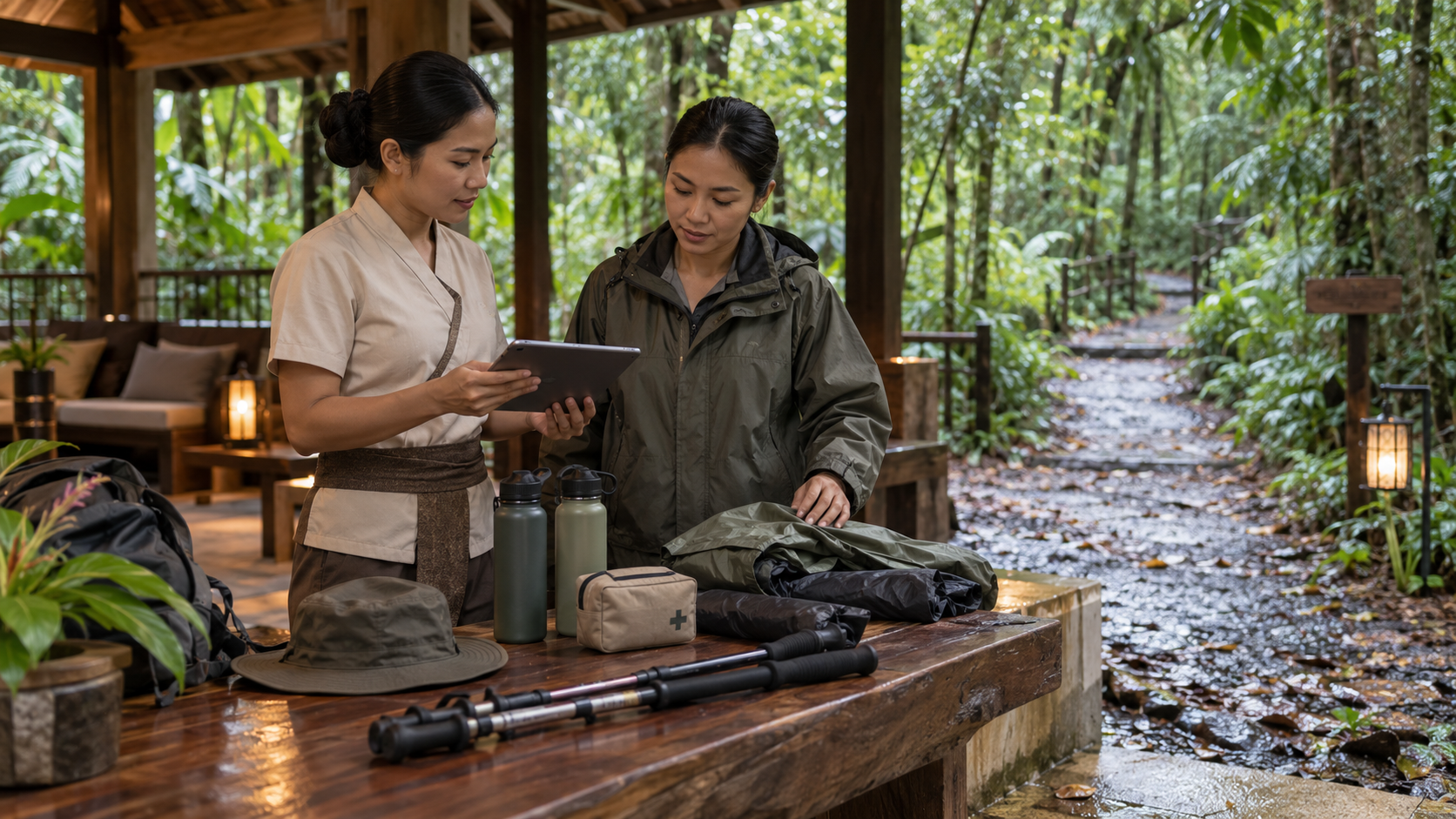
Give guests useful information before they commit. State the duration, surface, gradient, expected temperature and humidity, exposure to rain or sun, footwear, toilet access, insects and whether seats or sheltered alternatives are available. Explain that the activity is slow and sensory rather than a fitness walk. Ask only for information needed to manage participation safely, and provide a private way to discuss mobility, sensory or health concerns.
At the welcome
The facilitator should restate the format and make voluntary participation visible. Guests can be invited to notice sound, texture, colour, scent, temperature or movement without being required to close their eyes, touch plants, share emotions or speak in the group. Consent is not a single checkbox; it is the ability to decline an invitation without embarrassment.
During the route
Use short, clear sensory invitations and enough time for guests to respond in their own way. Keep the group within sight, use predetermined regrouping points and avoid handling plants or entering sensitive areas. Silence may be valuable, but it should be offered rather than enforced. Some guests feel safer with explanation or gentle conversation, while others prefer quiet.
At the close
Bring the group back to an obvious transition point. Offer water, seating and time to reorient before another treatment or scheduled activity. Reflection can be private, written or shared. The facilitator should not interpret an emotional response as a diagnosis or evidence that a therapeutic breakthrough occurred.
Build the route as an operating asset
A beautiful path is not automatically a suitable service route. Inspect it at the times and seasons when guests will use it. Record slippery surfaces, loose steps, low branches, water crossings, lighting changes, phone coverage, evacuation access, wildlife concerns, heat exposure and points where the group could become separated. Define who closes the route and what triggers that decision.
Weather is part of the product, not an exception to it. Set thresholds for storms, lightning, extreme heat, heavy rain, poor air quality and unsafe ground conditions. Prepare a sheltered or indoor sensory alternative that is honestly described as an alternative, not as the same experience. The decision to cancel should belong to a named role and should never be overruled because a premium guest has limited time.
The route also needs an ecological boundary. The joint IUCN–WHO report on nature-based solutions for health connects human wellbeing with biodiversity and resilient environments. For an operator, that means the programme should not damage the setting it relies on. Use authorised paths, appropriate group sizes, quiet behaviour and local environmental guidance. Do not encourage guests to pick plants, feed wildlife or create content in restricted areas.
Outdoor due diligence is already familiar territory for responsible wellness operators. The practical questions on partner competence, route control and emergency planning in the Thailand surf-therapy due-diligence guide transfer well, even though forest bathing is normally slower and less physically demanding.
Define facilitator competence and professional limits
The facilitator is not merely a person who knows the path. The role combines hospitality, group management, environmental awareness and the ability to make participation feel unforced. A spa should define competence before deciding whether the role belongs to a therapist, naturalist, external guide or jointly hosted team.
Training should cover route knowledge, weather decisions, first response, emergency communication, group counting, accessibility, sensory invitations, consent, privacy and claims boundaries. It should also include practice with real scenarios: a guest who becomes uncomfortable in silence, a participant who walks faster than the group, sudden rain, an insect reaction, an emotional disclosure or a request for medical advice.
The facilitator should be able to say, “That is outside the scope of this session,” and know the property's next step. The goal is not to suppress human warmth. It is to prevent a hospitable conversation from becoming an unqualified clinical interpretation. Where the programme involves local ecological or cultural knowledge, the relevant rights-holders and specialists should shape the content and receive agreed credit and compensation.
Use a training room to rehearse the welcome, route briefing and return sequence before going outside. The site's guide to designing a professional spa training room can support this work, especially when teams need to practise consistently across shifts or properties.
Design inclusion before the first booking
Forest bathing is often described as accessible because it is slow. Slow does not automatically mean inclusive. Uneven paths, heat, humidity, insects, distance from toilets, low seating, sensory sensitivity and group silence can all create barriers.
Map each section of the route by surface, gradient, distance and available rest points. Offer shorter loops, seated sessions, covered garden versions or paired facilitation where feasible. Give guests the information needed to choose, without asking them to justify their needs publicly. A companion should not be required unless a documented safety assessment makes one necessary.
Choice also applies to sensory participation. Strong fragrance, touching bark, barefoot walking and eye-closing should never be assumed. Provide neutral alternatives. A useful standard is equivalence of attention: guests may engage through sight, sound, temperature, movement or supported reflection without having to perform the same action.
Measure the service before scaling it
A pilot should test whether the programme can be delivered reliably, not attempt to prove a medical outcome. Start with a small number of sessions and a defined review date. Record the route, weather, duration, group size, facilitator, changes made, incidents, near misses and accessibility requests met.
Guest feedback should separate different questions. Did the description match the experience? Did the guest feel able to opt out of invitations? Was the pace comfortable? Did the facilitator communicate clearly? Was the setting managed respectfully? Would the guest recommend the experience? These measures are more actionable than a single satisfaction score.
Commercial measures can include enquiry-to-booking conversion, attendance, cancellation, staffing time, contribution margin and attachment to treatments or stays. Interpret them carefully. Strong bookings show demand for the offer, not proof of health benefit. High satisfaction can reflect the guide, weather, group or wider resort experience as much as the forest-bathing format itself.
After 30 to 60 days, review four decisions: continue, adapt, pause or stop. Expansion should require consistent delivery, no unresolved safety or ecological issue, adequate facilitator capacity and guest communication that matches reality.
A practical launch sequence
Weeks 1–2: define and assess
Write the service definition, audience and non-negotiable claims boundary. Inspect possible routes with operations, environmental and safety input. Choose the route only after comparing access, weather exposure, ecological sensitivity and emergency response.
Weeks 3–4: script and rehearse
Create the pre-arrival description, welcome, sensory invitations, opt-out language, stop conditions and closing sequence. Train at least two facilitators so the service does not depend on one person. Rehearse in wet and dry conditions and test the accessible alternatives.
Weeks 5–8: run a controlled pilot
Limit group size and departures. Debrief after every session. Compare actual timing and guest needs with the written design. Correct the route, script or staffing before increasing marketing.
At the review: publish only what records support
Update the public description from observed delivery. Keep health language within the evidence and the operator's authority. Use operational quality, guest choice and environmental care as the central promise.
Conclusion: the forest is not the full product
Forest bathing offers spas and resorts a low-infrastructure way to connect hospitality with place, but the absence of complex equipment does not make the service self-managing. Its credibility depends on preparation, facilitation, consent, route governance, inclusion, claims discipline and review.
The strongest programmes will resist two shortcuts: treating nature as a decorative backdrop and treating early evidence as a marketing guarantee. They will describe the experience precisely, train people to host it well and measure what the operation can genuinely observe. In that model, the forest provides the setting; the spa earns trust through the quality of the service built around it.
Practical quality check for Forest Bathing for Spas: From Scenery to Service
People topics only matter when they change daily behavior. For this article, the test is simple: can a spa owner read "Forest Bathing for Spas: From Scenery to Service" and know what to check, what to improve and what result should change in the business? If the answer is vague, the topic needs to be translated into a concrete operating decision, not left as a broad marketing idea.
Use this topic as a short management review. Compare the current guest journey with the promise in the title, then look for gaps in training records, service observations, therapist confidence and guest feedback. The strongest version of the article is the one that connects the idea to real rooms, real staff behavior, real booking steps and real follow-up after the visit.
Owner checklist
- Define the decision: write what the owner, manager or front desk should change after reading about Forest Bathing for Spas: From Scenery to Service.
- Check the evidence: collect the page, listing, menu, script, photo, review or operating report that proves the current situation.
- Protect the guest experience: make sure the change improves clarity, comfort, trust, timing or consistency for the client.
- Choose one measure: review booking accuracy, staff adoption, data completeness and time saved per workflow so the team can tell whether the improvement worked.
How NUAD SPA would apply it
NUAD SPA would treat Forest Bathing for Spas: From Scenery to Service as a focused workstream, not an isolated article topic. The first step is to map the current process, then decide whether the main blocker is positioning, service design, team execution, digital visibility, booking friction or retention. That diagnosis keeps the recommendation close to the title and avoids generic advice.
The next step is a two-week action sprint: update one public-facing touchpoint, brief the team on the new standard, test the booking or service flow, and collect feedback from staff and guests. This makes the article useful because it creates a next move, not only a point of view.
Risks to avoid
The common mistake is to make Forest Bathing for Spas: From Scenery to Service sound bigger than the spa can operationally support. A campaign can create demand the reception cannot answer; a new treatment can promise benefits the team has not been trained to deliver; a design trend can look attractive but reduce flow or profitability. The safer approach is to pair every idea with an owner, a checklist and a visible standard.
Frequently Asked Questions
What is forest bathing in a spa setting?
It is a slow, guided sensory experience in a suitable natural setting. It normally emphasises attention, gentle movement and choice rather than hiking distance, fitness performance or a clinical treatment outcome.
Does a forest-bathing facilitator need to be a therapist?
Not necessarily. The operator should define competence for the actual programme, including route safety, group management, consent, sensory facilitation, accessibility, emergency communication and professional boundaries. Clinical advice remains outside scope unless a properly qualified professional is separately authorised to provide it.
Can a spa claim that forest bathing treats stress?
A spa should not promise treatment of stress or another condition from a general programme. It can describe the setting, pace, sensory invitations and hosted experience. Any health claim must match robust evidence, local rules and the provider's professional authority.
How large should a forest-bathing group be?
There is no universal number. Set the limit from route width, sight lines, facilitator capacity, ecological sensitivity, emergency response and the quiet experience promised. Test a conservative limit during the pilot and increase it only when records support the change.
What should a spa measure during a pilot?
Track delivery time, route and weather, group size, facilitator, accessibility requests met, opt-outs, incidents, near misses, guest understanding, perceived pace, description accuracy, satisfaction, staffing time, booking conversion and contribution margin. Do not present these operational measures as clinical outcomes.
Sources and References
- Journal of Business, Innovation and Sustainability — Experiential Marketing Strategies for Forest Bathing
- Crossref record — Guided Forest Bathing as a Wellness Resort Experience
- Japan Forestry Agency — Forest Bathing
- World Health Organization — Green and blue spaces and mental health
- WHO and IUCN — Nature-based Solutions for Health
Need to turn this diagnosis into an action plan? Talk to NUAD SPA.