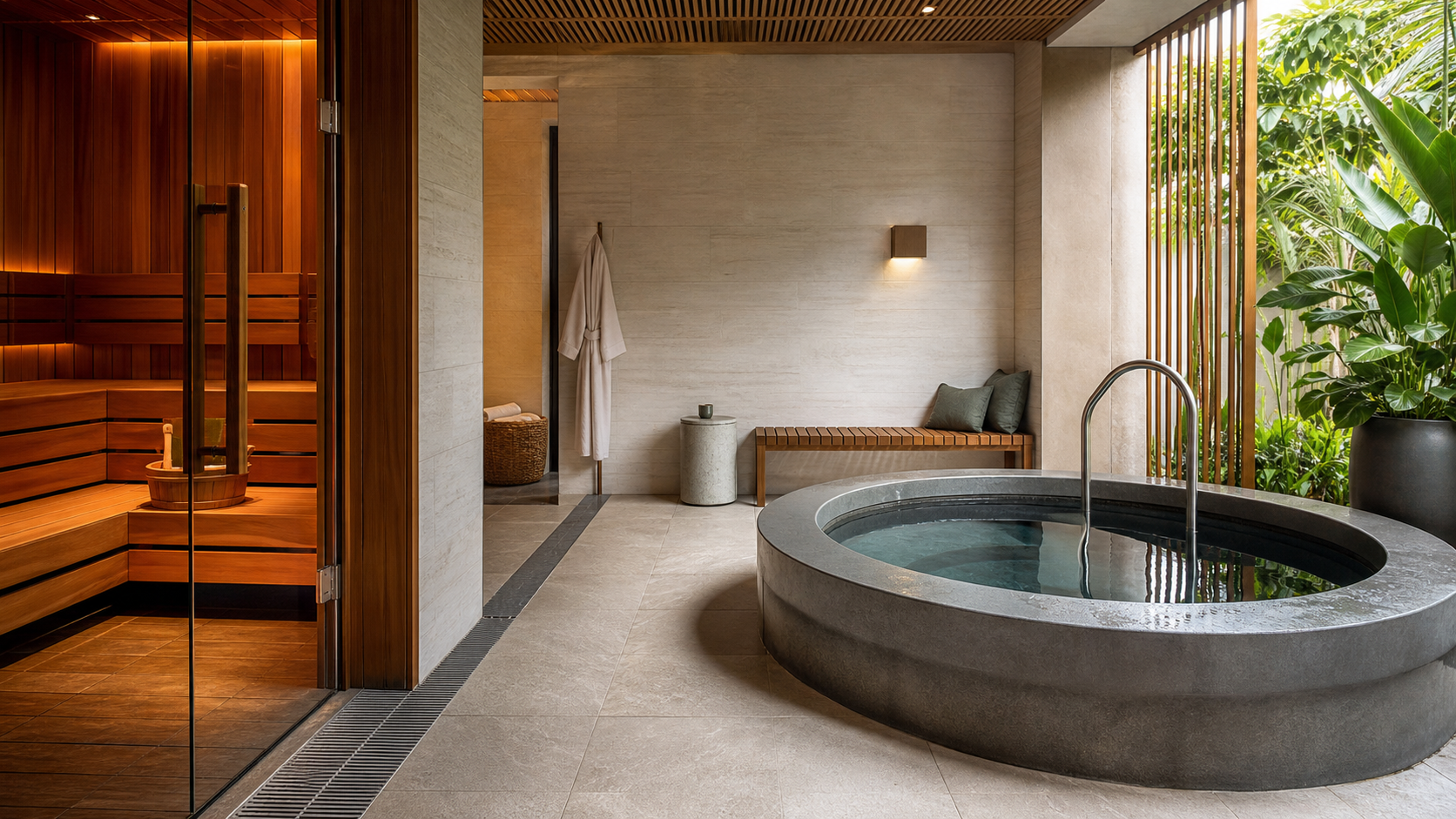
Contrast hydrotherapy can look simple from the guest's point of view: move between heat and cold, then rest. For a spa operator, however, it is a managed sequence involving screening, water quality, temperature control, supervision, circulation, recovery space and careful communication. The value is not created by installing a dramatic cold plunge beside a sauna. It comes from turning those elements into a coherent, repeatable and appropriately cautious service.
Interest in contrast experiences is rising, but the evidence does not justify sweeping promises. Current research supports a narrower position: alternating heat and cold can create measurable short-term physiological responses, and contrast water therapy may help some markers of recovery after strenuous exercise. Results depend on the protocol, population and outcome being measured. That makes operational discipline especially important.
This guide translates the available evidence into practical decisions for spa owners, hotel operators and wellness developers. It is not medical advice and does not replace local public-health, pool, building, electrical or workplace requirements.
What contrast hydrotherapy is—and is not
Contrast hydrotherapy alternates exposure to heat and cold. Formats include a sauna followed by a cold plunge, hot and cold pools, steam followed by a cool shower, or repeated warm and cold water immersion. A spa may offer one guided circuit or allow guests to move through a supervised thermal area within defined limits.
The experience should not be sold as a universal treatment. “More extreme” is not a meaningful quality standard, and a lower water temperature is not automatically better. A well-designed service gives guests clear expectations, a safe way to stop, time to recover and choices that reflect different levels of familiarity. It also avoids implying that one protocol will produce the same result for every person.
The Global Wellness Institute's Contrast Hydrotherapy Research Spotlight is useful because it separates promising observations from established conclusions. It describes short-term cardiovascular and autonomic responses while noting that protocols vary and many studies are small. Operators can use this evidence to shape responsible language, but not to diagnose conditions or guarantee clinical outcomes.
What the current evidence can support
Recovery after strenuous exercise
A 2024 network meta-analysis indexed by PubMed examined 57 studies involving 1,220 healthy participants after exercise-induced muscle damage. Contrast water therapy ranked highest for reducing creatine kinase, a biochemical marker often used in recovery research. Other cold therapies ranked more strongly for perceived muscle soreness and jump performance. The practical lesson is not that contrast therapy “wins” in every category; it is that different recovery methods may influence different outcomes.
The study population and setting also matter. Findings in healthy people after strenuous exercise cannot automatically be extended to guests with chronic illness, older adults, pregnant guests or anyone seeking treatment for a medical problem. A separate 2024 systematic review of 18 articles and 499 healthy participants found no significant advantage for contrast water therapy over passive recovery in the performance and fatigue indicators it assessed. Nearly all participants in that review were male. Together, these reviews support careful, outcome-specific language rather than a broad recovery claim.
Short-term cardiovascular and autonomic responses
Recent small studies have recorded changes in heart rate, blood pressure and autonomic measures during or after sauna and cold-water sequences. These observations confirm that contrast exposure is physiologically active. They do not establish long-term cardiovascular benefit, nor do they make the experience suitable for everyone.
Heat and cold impose different demands. Cold water can trigger involuntary gasping, faster breathing and acute increases in heart rate and blood pressure. Heat can increase sweating and fluid loss. Operators should assess the complete sequence rather than treating a preceding warm phase as a substitute for cold-water controls.
The honest evidence statement
A defensible guest-facing statement is modest: contrast hydrotherapy is a thermal wellness experience that alternates heat and cold; some research suggests potential short-term recovery effects after strenuous exercise, while responses vary and the broader evidence remains limited. This tells the truth without turning an amenity into a medical claim.
Avoid promises to “detoxify”, cure inflammation, strengthen immunity, prevent disease or deliver a guaranteed cardiovascular benefit. If the service is positioned for athletes, distinguish relaxation and subjective readiness from a verified performance result. Marketing, intake forms, staff scripts and booking-platform copy should use the same approved wording.
Turn evidence into a safer guest proposition
Safety begins before the guest enters the wet zone. The joint position statement from Royal Life Saving Society Australia, AUSactive and the Swimming Pool & Spa Association of Australia recommends screening, informed briefing, gradual acclimatisation, qualified supervision and a practised emergency plan for cold-water immersion. It also identifies cold shock, hyperventilation, arrhythmia, cramps, hypothermia, panic and inhalation of water among the risks operators must consider.
Create a concise pre-participation process with input from the appropriate local clinical and legal professionals. It should identify circumstances requiring refusal, postponement or medical clearance; explain the experience in plain language; and give the guest an unambiguous right to stop. Staff should never improvise medical advice. A scripted escalation such as “This is outside our scope, so we need you to speak with a qualified healthcare professional before participating” protects both guest and team.
The Australian position statement describes 10–15°C as a generally safe cold-water range for most people, but that is not a universal operating prescription. Local rules, equipment specifications, water depth, exposure time, supervision, guest profile and the preceding heat exposure all affect risk. Operators should obtain jurisdiction-specific advice and document why their chosen limits are appropriate.
Brief guests before they are wet or heat-stressed. Explain where to enter and exit, how staff communicate, what sensations may occur, which behaviours are prohibited and where to rest. Encourage controlled breathing and a gradual entry rather than a competitive plunge. Keep the head and neck out of the water, provide stable handholds, and make the shortest route out visually obvious.
Design the guest flow, not just the equipment
A contrast suite is a journey through briefing, changing, warm exposure, transition, cold exposure, recovery and departure. Each step needs enough space and a clear decision point. Guests should not cross a slippery traffic lane to reach the cold element, carry towels through a clean preparation zone or search for a staff member while distressed.
Start with adjacency. Place the heat and cold elements close enough for controlled movement but not so close that steam, splash or condensation compromises equipment or visibility. Provide non-slip surfaces, drainage that handles peak splash, stable steps and handrails, rounded circulation paths and lighting that reveals level changes. The Western Australia Department of Health guidance for commercial ice baths highlights safe access and egress, protection from entrapment, treatment-system interlocks, electrical compliance, rules, barriers and resuscitation information.
Sightlines should allow active supervision without making guests feel displayed. A staff position needs a clear view of the entry, immersion point and exit. Avoid decorative screens that conceal a person in difficulty. Emergency equipment must be accessible without crossing the same wet path used by guests.
Recovery is a functional zone, not spare furniture. Provide a temperate area with seating, drinking water and enough calm for breathing and balance to normalise. A guest who chooses to end the sequence should be able to move directly to recovery without passing through heat again. Thoughtful spa concept design coordinates atmosphere with drainage, utilities, supervision and service flow before expensive equipment is fixed in place.
Build operating controls before marketing
The opening checklist should prove that the space is ready, not merely record that someone opened it. Confirm actual water and room temperatures with suitable instruments; inspect steps, rails, drains and covers; verify treatment and recirculation systems; complete the required water-quality tests; check communication and emergency equipment; and document corrective action before admitting guests.

Commercial plunge pools require a water-management plan appropriate to their design and local public-health rules. Define filtration, disinfection, turnover, bather-load limits, testing frequency, cleaning, backwashing or water replacement, microbiological response and closure thresholds. A cold temperature does not make untreated shared water hygienic. Supplier instructions are inputs to the plan, not substitutes for regulatory requirements.
Write the complete sequence into spa operating procedures. Include booking information, screening, informed briefing, guest preparation, staff position, permitted sequence, temperature and time boundaries, stop criteria, cleaning between users, daily maintenance, incident management and escalation. Each instruction needs an owner, a record and a response when the result falls outside the approved range.
Train staff to recognise distress rather than admire endurance. Warning signs may include uncontrolled breathing, confusion, loss of coordination, chest discomfort, unusual weakness, panic or inability to exit independently. The operating response should specify when to stop the session, support egress, provide first aid, call emergency services, close the facility and preserve an incident record. Teams should rehearse realistic scenarios with the equipment and staffing level used in normal operation.
Maintenance must be designed around service availability. Record faults, isolate defective equipment and prevent reopening through informal workarounds. If temperature control, circulation, sanitation, safe access or supervision cannot meet the documented standard, the affected element is closed. Revenue pressure is not a risk control.
Create a protocol guests can understand
A first-time guest needs a gentler pathway than an experienced regular. Offer a clear introduction with conservative exposure, sufficient transition time and no pressure to complete multiple rounds. Staff can describe options and observe response, but the guest must retain control within the safe operating limits. Competitive challenges, leaderboards and “prove your toughness” language are incompatible with a premium duty of care.
Keep the protocol simple enough to remember. A useful briefing covers five points: the route, expected sensations, breathing, stop signals and recovery. Use pictograms only as a supplement to spoken and written instructions, and test every sign at normal viewing distance in steam and low light. Where guests speak different languages, translate the safety-critical meaning professionally rather than relying on improvised interpretation.
Set capacity by supervision and water treatment, not by the number of bodies that physically fit. A staff member who is checking in another guest, replenishing towels and cleaning a shower cannot simultaneously provide attentive plunge supervision. Map each role during quiet and peak periods, then restrict bookings when the safe staffing model cannot be met.
Measure the service without encouraging extremes
Operational measures should reveal whether the service is controlled and useful. Track utilisation by time of day, completion and early-exit rates, staff interventions, water-quality exceptions, equipment downtime, cleaning time, incidents and near misses. Guest feedback can cover clarity of briefing, perceived comfort, sense of control and satisfaction with recovery space.
Do not reward colder temperatures, longer exposures or more cycles. Those numbers can encourage guests and staff to treat intensity as achievement. Measure repeat bookings and attachment to relevant spa services, but review them alongside incidents and complaints. A service that sells well while generating repeated safety interventions is not operating successfully.
Compare actual behaviour with the original business case. If most guests use only one element, the issue may be briefing, adjacency, comfort or positioning. If the plunge is frequently closed, investigate bather load, maintenance access and treatment capacity before adding sessions. If guests repeatedly ask medical questions, revise the marketing and staff script so the scope is clearer.
A practical 30-day pilot
During week one, approve the risk assessment, guest criteria, claims language, SOP, water-management plan and emergency response with the relevant professionals. Verify the physical route from changing area to recovery and close every unresolved access, drainage, electrical or supervision issue.
During week two, train the smallest operating team. Rehearse normal sessions, a guest who stops early, a water-quality failure, an equipment fault and a medical emergency. Observe whether each person knows their position, authority and communication route. Correct the system rather than relying on one highly experienced employee.
During week three, invite a limited number of suitable participants, use conservative capacity and collect structured feedback. Review temperature logs, water results, briefing consistency, transitions and recovery. Do not expand because the imagery performs well on social media; expand only when the operating evidence is sound.
During week four, close corrective actions and decide whether to continue, revise or pause. Approve final marketing only after it matches the tested experience. Schedule audits, refresher drills, water-plan reviews and preventive maintenance. A premium contrast service should become more controlled as demand grows, not less.
Conclusion
Contrast hydrotherapy can be a compelling addition to a spa, but the commercial opportunity is inseparable from operational responsibility. Evidence supports restrained claims, not a catalogue of cures. A strong concept combines thoughtful spatial design, conservative screening, safe access, controlled water, trained supervision, explicit stop criteria and a calm recovery phase.
The most credible operators will make safety visible without making the experience feel clinical. They will give guests agency without leaving them unsupported, and they will measure quality without celebrating extremes. That is how two pieces of thermal equipment become a dependable wellness service.
Frequently Asked Questions
What is contrast hydrotherapy?
Contrast hydrotherapy alternates heat and cold, such as a sauna followed by a cold plunge or warm and cold water immersion. Formats and physiological responses vary, so operators should define the sequence precisely and avoid presenting every contrast experience as equivalent.
What temperature should a spa cold plunge use?
There is no universal setting for every facility or guest. Australian sector guidance describes 10–15°C as generally safe for most people, but local rules, depth, exposure time, supervision, preceding heat and guest profile all matter. Operators need a documented, jurisdiction-appropriate limit rather than copying an online challenge.
Can spas market contrast hydrotherapy as a medical treatment?
Non-medical spas should not diagnose, treat or promise cures. Current evidence supports cautious descriptions of a thermal wellness experience and possible short-term recovery effects in specific exercise settings. Claims should be reviewed for the operator's jurisdiction and remain consistent across staff scripts, websites and booking channels.
What should a contrast hydrotherapy SOP include?
It should cover booking information, screening, briefing, permitted use, staff supervision, temperatures and timing, stop criteria, water testing, cleaning, equipment checks, emergency response, incident reporting and reopening after a fault. Every control needs a named owner and a record.
How should a spa test a new contrast circuit?
Begin with a limited pilot after the physical, water-quality, staffing and emergency controls are approved. Rehearse normal and failure scenarios, monitor interventions and early exits, gather structured feedback, close corrective actions and expand capacity only when the operating evidence supports it.
Sources and References
- Global Wellness Institute: New GWI Resource Spotlights the Evidence Behind Contrast Hydrotherapy
- Global Wellness Institute: Contrast Hydrotherapy Research Spotlight
- PubMed: Network meta-analysis of recovery methods after exercise-induced muscle damage
- PubMed: Systematic review and meta-analysis of contrast water therapy
- Royal Life Saving Society Australia, AUSactive and SPASA: Cold Water Immersion Position Statement
- Western Australia Department of Health: Ice Baths for Commercial and Public Use
Need to turn this diagnosis into an action plan? Talk to NUAD SPA.