
Electromagnetic fields are becoming part of wellness-design conversations, but a calm room, a compliant installation and a proven health benefit are three different things. Spa and hotel leaders need a disciplined way to assess exposure, measurements, guest concerns and supplier claims before turning an invisible condition into a wellness promise.
Key takeaways
- Do not treat “EMF” as one substance. Static, low-frequency and radiofrequency fields have different sources, units and established effects.
- Separate four questions: legal compliance, equipment interference, guest comfort and health marketing. Evidence for one does not prove the others.
- Do not advertise an “EMF-free” room. Natural and human-made fields are part of the environment, and the phrase has no useful technical boundary.
- Use competent measurement only for a defined decision, with the right instrument, frequency range, calibration record and operating conditions.
- Respond respectfully to symptoms and device concerns without diagnosing a cause or promising that shielding, switch-off routines or products will treat them.
Why wellness spaces need an EMF claims audit
An October 2026 article from the Global Wellness Institute's Touchless Wellness Initiative brought electromagnetic exposure into the built-environment discussion. The industry commentary on the “invisible layer” proposes design responses such as increasing distance from sources, using wired connections and reducing wireless activity near sleeping areas. It also associates exposure with sleep and physiological regulation.
That makes EMF a current hospitality issue, but the article itself mixes design ideas, selected studies and first-person experience. An anecdote about sleep improving after a move cannot establish that an adjacent antenna caused the original problem. A design preference can still be offered, yet it should not be converted into a medical, sleep or recovery claim without evidence that supports that exact claim.
The commercial risk is easy to see. A supplier may offer shielding paint, fabric, glazing, meters or “harmonising” devices. A hotel may describe a room as low-EMF, EMF-safe or restorative. A guest may then understand the wording as a verified health guarantee. If the operator cannot define what was measured, against which limit, in what conditions and by whom, the promise is not auditable.
The solution is not to dismiss the subject. It is to put each question in the right evidence lane.
First, define what is being discussed
Electromagnetic fields cover a wide frequency range. The UK Health Security Agency's updated guidance on sources and health effects describes fields from static conditions at 0 hertz through low-frequency electricity systems to radio waves up to 300 gigahertz. At low frequencies, electric and magnetic components are largely independent. At higher radio frequencies, they combine and propagate away from a source.
Those distinctions matter operationally. Mains wiring, an induction appliance, a Wi-Fi access point, a mobile phone and a strong industrial transmitter are not interchangeable sources. Measurements also use different quantities, including volts per metre, microtesla, watts per square metre and specific absorption rate. A single number from a consumer meter cannot describe every kind of field or determine every kind of risk.
EMFs in this range are non-ionising radiation: they do not carry enough quantum energy to ionise living matter. That does not mean every exposure level is harmless. It means the protection question must be tied to frequency, intensity, duration and a recognised mechanism rather than to the word “radiation” alone.
For radiofrequency fields, UKHSA identifies heating as the main biological effect at sufficient exposure levels. For low-frequency fields, recognised effects at high enough levels include induced currents and nerve stimulation. Public exposure is typically well below the International Commission on Non-Ionizing Radiation Protection guidelines, according to UKHSA.
What current health guidance does and does not say
The World Health Organization's overview of electromagnetic fields says the evidence it reviewed did not confirm health consequences from low-level exposure, while acknowledging that knowledge gaps remain. It also states that scientific evidence does not support a link between low-level fields and the diffuse symptoms sometimes attributed to them.
That is not permission to ignore exposure standards. The ICNIRP radiofrequency guidelines cover 100 kilohertz to 300 gigahertz and set restrictions intended to protect people from substantiated adverse health effects. They include Wi-Fi, Bluetooth, mobile communications and related technologies. The guidelines also make clear that medical procedures and electromagnetic interference with active implanted devices require separate expertise.
It is equally important not to reverse the logic. Compliance with an exposure limit does not prove that a room improves sleep, balances hormones or accelerates recovery. It answers a protection question under defined conditions. A wellness outcome would require evidence for the intervention, population and outcome being marketed.
Operators should therefore avoid two extremes: presenting ordinary wireless infrastructure as inherently harmful, or using compliance as a broad wellness endorsement. The evidence supports a narrower and more responsible position.
Use a four-lane decision model
1. Exposure compliance
Identify the equipment, frequency range, operating conditions and people who may be exposed. Determine which national rules and technical standards apply. Compliance assessment belongs with competent telecommunications, electrical, occupational-safety or building-services professionals, depending on the source.
The International Telecommunication Union's 2024 Recommendation ITU-T K.91 provides guidance for assessing, evaluating and monitoring human exposure to radiofrequency fields. It distinguishes unrestricted public environments from restricted occupational settings and recommends harmonised, science-based limits such as the current ICNIRP or IEEE frameworks where a country does not apply its own expert limits. A project in Thailand should still confirm current national requirements and applicable standards with a qualified local specialist rather than importing another jurisdiction's table.
2. Electromagnetic compatibility
Fields can interfere with some active implanted or body-worn medical devices even when the issue is not a direct biological effect. A spa should follow equipment manufacturer instructions, device-maker advice and clinical guidance. Staff should never improvise a universal “safe distance” for pacemakers, insulin pumps or other devices.
Ask about relevant devices only when a treatment or piece of equipment creates a real compatibility concern, and collect the minimum information needed. A non-clinical spa should not interpret a guest's device specifications. If the safe route is unclear, pause the service and refer the guest to the device manufacturer or treating clinician.
3. Guest comfort and choice
A property may offer wired internet, a router switch-off option, a device drawer or a low-connectivity rest period as a preference. These can support digital boundaries, privacy, reduced notifications or a calmer ritual. Describe the choice in those terms unless stronger evidence supports more.
Test the operational consequences. Turning off a network must not disable emergency communications, locks, fire systems, staff alerts, environmental controls or required monitoring. A comfort feature that creates a safety or service failure is not a successful wellness intervention.
4. Health and recovery claims
Claims such as “detoxes electromagnetic radiation”, “normalises melatonin”, “protects the nervous system” or “improves sleep by reducing EMF” require direct and reliable support. A supplier's testimonial, before-and-after meter photo or general paper about biological activity does not prove a product delivers the advertised result in a spa room.
This is the same scope discipline needed for medical screening at wellness resorts and intensive breathwork governance: define what the service is, what evidence supports, who is competent to deliver it and where referral begins.
Run a seven-step EMF due-diligence review
1. Write the decision before commissioning a survey
State the exact question. Is the project checking regulatory compliance, investigating interference, comparing two equipment layouts or responding to a guest concern? A broad request to “measure the room's EMF” invites an impressive-looking report that may not answer a useful question.
2. Build a source and operating-state inventory
List fixed transmitters, access points, electrical panels, motors, heating systems, treatment equipment and high-current devices. Record their normal, maximum and standby states. Include neighbouring plant rooms or antennas when relevant. A measurement taken with equipment off cannot describe peak operation.
3. Select competent assessment
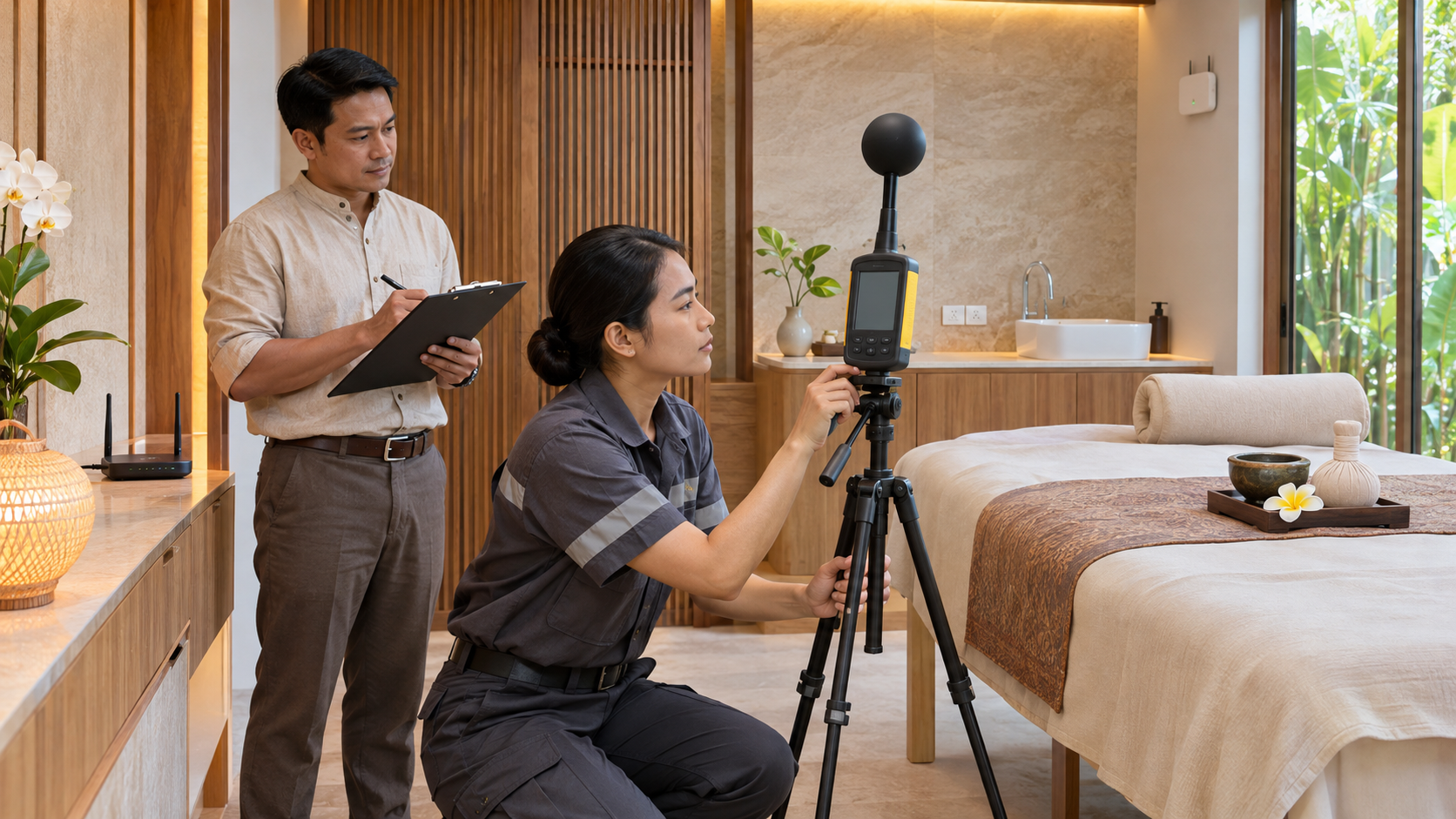
Ask the assessor to document competence, instrument model, frequency range, calibration, uncertainty, sampling locations, height, duration and operating conditions. The meter must match the source. A device designed for one band should not be used to make claims about the entire spectrum.
Do not use a colourful handheld reading as a diagnostic tool. Consumer meters can be useful for locating certain sources when their limitations are understood, but they do not replace a standards-based assessment or medical evaluation.
4. Compare results with the right reference
A result needs a unit, frequency, averaging method and applicable limit. Distinguish public and occupational criteria. Do not compare a peak reading in one unit with a guideline expressed in another, or present any non-zero value as a failure.
5. Test proposed controls as a system
If a project changes equipment location, cabling, power routines or shielding, assess connectivity, electrical safety, fire systems, access control, maintenance and emergency response. Shielding can also change signal behaviour and may cause connected devices to work harder to maintain service. A specialist should evaluate the actual design rather than relying on an intuitive fix.
6. Audit every supplier claim
Request the test standard, independent laboratory, product configuration, baseline, control condition, result, uncertainty and date. Ask whether the evidence demonstrates exposure reduction, regulatory compliance or a health outcome. Those are different claims.
A product may measurably attenuate a particular field under laboratory conditions without improving sleep or wellbeing in a real room. Marketing should stop where the evidence stops.
7. Approve language and ownership
Engineering owns infrastructure facts. A competent specialist owns measurement interpretation. Operations owns the switch-off and maintenance process. Legal or compliance review owns the public claim. Guest-facing staff need a short explanation and an escalation route, not a script that turns them into radiation or medical experts.
Respond to guest concerns without dismissal or diagnosis
Some guests report headaches, fatigue, sleep disturbance or other symptoms that they attribute to electromagnetic exposure. The symptoms can be real and distressing even when causation has not been established. Staff should listen, check for urgent needs, offer ordinary service-recovery choices and avoid arguing about science at reception.
UKHSA's 2026 guidance on electromagnetic hypersensitivity relays WHO's position that there are no clear diagnostic criteria and no scientific basis for linking the reported symptoms to EMF exposure. The practical implication for a spa is careful scope: address the person and the service issue without confirming a cause.
A useful response may include moving the guest away from a noisy plant room, helping them switch off a device, offering a room without an optional connected feature, documenting the concern and suggesting medical advice when symptoms require it. Do not promise that relocation or a product will treat the symptoms. Do not collect a detailed health history merely to manage a room preference.
The site's guide to wellness hotel room operations is relevant here: clear controls, choice, privacy, maintenance and service recovery are valuable whether or not EMF is the stated concern.
Measure the operating decision, not an invisible wellness score
If a property pilots a wired room or switch-off routine, track what the operator can responsibly influence:
- Readiness: whether the configured room passes its technical and safety checks.
- Demand: how many guests knowingly choose the option and why.
- Usability: support requests, connectivity failures and staff time.
- Guest response: perceived calm, ease and overall room satisfaction, described as subjective experience rather than diagnosis.
- Risk: device concerns, complaints, incidents, emergency-system conflicts and misleading claim corrections.
- Economics: design cost, survey cost, maintenance, lost functionality, room-rate difference and repeat selection.
Do not combine these into a proprietary “wellness frequency” score. Report the decision in plain language: what was changed, what was measured, what standard was used, what guests preferred and what remains unknown.
Conclusion
EMF can be managed responsibly without turning it into fear or a cure. A spa or hotel should identify the real source, apply current exposure and equipment guidance, use competent measurement when needed, protect people with medical-device concerns and give guests practical choice.
The strongest wellness claim may be the most modest one: this room has understandable controls, tested systems and options that respect how a guest wants to disconnect. Anything beyond that should be supported by evidence for the exact exposure, intervention and outcome being advertised.
Practical quality check for EMF in Wellness Spaces: Evidence Before Claims
Digital topics are valuable when they remove friction from the guest journey and the team workflow. For this article, the test is simple: can a spa owner read "EMF in Wellness Spaces: Evidence Before Claims" and know what to check, what to improve and what result should change in the business? If the answer is vague, the topic needs to be translated into a concrete operating decision, not left as a broad marketing idea.
Use this topic as a short management review. Compare the current guest journey with the promise in the title, then look for gaps in booking data, response quality, system adoption, page clarity and operational handoffs. The strongest version of the article is the one that connects the idea to real rooms, real staff behavior, real booking steps and real follow-up after the visit.
Owner checklist
- Define the decision: write what the owner, manager or front desk should change after reading about EMF in Wellness Spaces: Evidence Before Claims.
- Check the evidence: collect the page, listing, menu, script, photo, review or operating report that proves the current situation.
- Protect the guest experience: make sure the change improves clarity, comfort, trust, timing or consistency for the client.
- Choose one measure: review qualified enquiries, confirmed bookings, response time and review quality so the team can tell whether the improvement worked.
How NUAD SPA would apply it
NUAD SPA would treat EMF in Wellness Spaces: Evidence Before Claims as a focused workstream, not an isolated article topic. The first step is to map the current process, then decide whether the main blocker is positioning, service design, team execution, digital visibility, booking friction or retention. That diagnosis keeps the recommendation close to the title and avoids generic advice.
The next step is a two-week action sprint: update one public-facing touchpoint, brief the team on the new standard, test the booking or service flow, and collect feedback from staff and guests. This makes the article useful because it creates a next move, not only a point of view.
Risks to avoid
The common mistake is to make EMF in Wellness Spaces: Evidence Before Claims sound bigger than the spa can operationally support. A campaign can create demand the reception cannot answer; a new treatment can promise benefits the team has not been trained to deliver; a design trend can look attractive but reduce flow or profitability. The safer approach is to pair every idea with an owner, a checklist and a visible standard.
Frequently Asked Questions
What does EMF mean in a spa or hotel?
EMF means electromagnetic field. The term covers static, low-frequency and radiofrequency fields from different natural and human-made sources. The source, frequency, intensity and duration must be defined before exposure or risk can be assessed.
Can a spa honestly call a room EMF-free?
No room is literally free of electromagnetic fields, including natural fields. “EMF-free” also fails to identify a frequency, measurement method or threshold. Describe a verified design choice, such as wired connectivity or an optional router switch-off routine, without implying a proven health benefit.
Should a spa measure EMF levels?
Measure only for a defined compliance, interference, design or investigation question. Use a competent assessor and an instrument suited to the relevant frequency range. Record calibration, operating conditions, locations, units, uncertainty and the standard used for comparison.
How should staff respond to guests who report EMF sensitivity?
Listen respectfully, check for urgent symptoms, offer reasonable service choices and document the concern. Do not diagnose the cause, promise that an EMF reduction will treat symptoms or debate the guest. Suggest appropriate medical advice when symptoms warrant it.
What about guests with pacemakers or other implanted devices?
Electromagnetic interference can be a separate equipment-compatibility issue. Follow the spa-equipment manufacturer, medical-device manufacturer and treating clinician's guidance. If compatibility is unclear, pause the service rather than inventing a universal safe distance.
Sources and References
- Global Wellness Institute — The Invisible Layer: Electromagnetic Exposure and Human Health in the Built Environment
- UK Health Security Agency — Electromagnetic fields: sources and health effects
- World Health Organization — Radiation: electromagnetic fields
- International Commission on Non-Ionizing Radiation Protection — RF EMF Guidelines 2020
- International Telecommunication Union — Recommendation ITU-T K.91 on RF-EMF exposure assessment
- UK Health Security Agency — Electromagnetic fields: electromagnetic hypersensitivity
Need an evidence and operations audit for a spa or wellness concept? Talk to NUAD SPA.