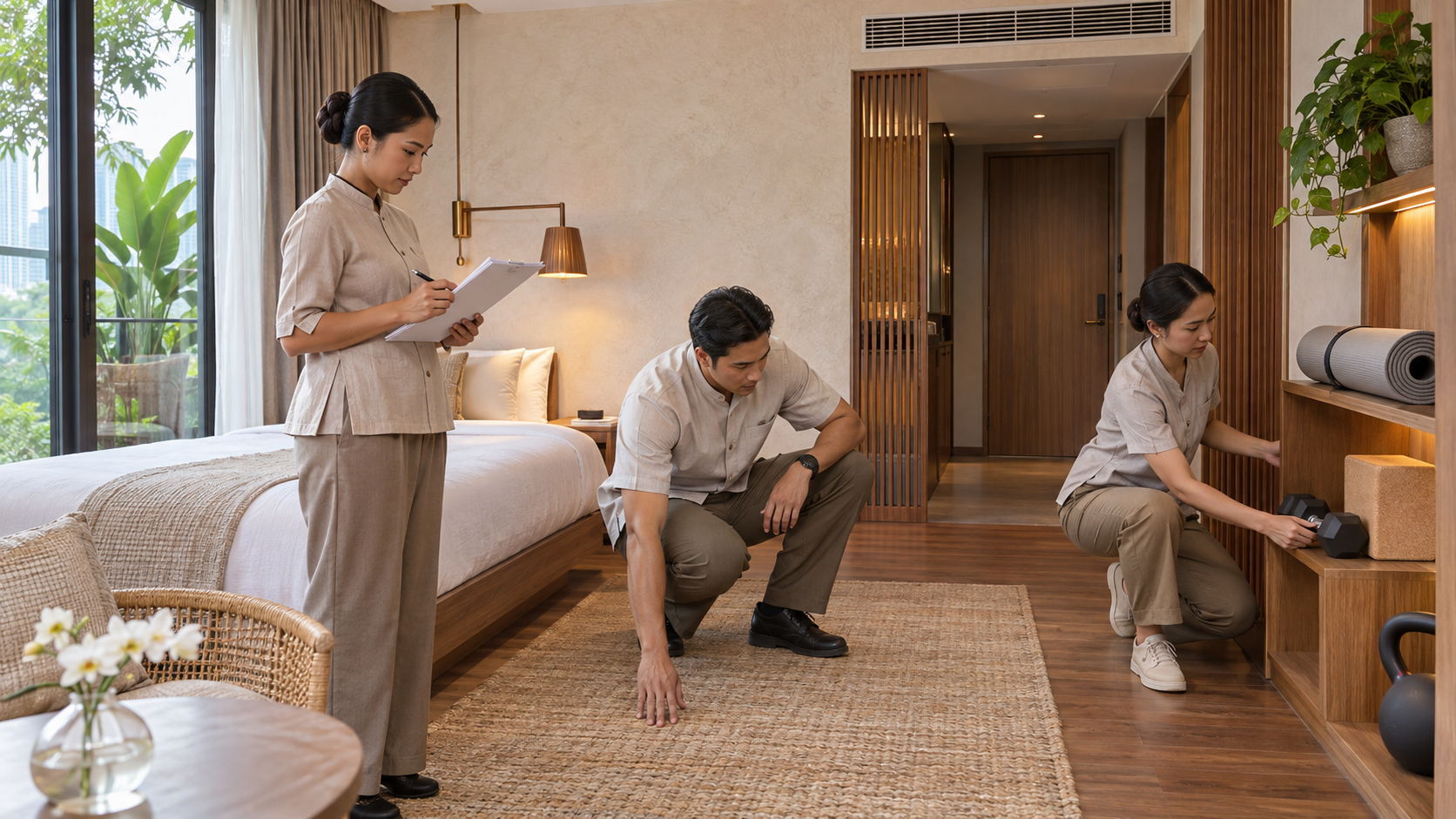
A yoga mat, circadian lamp or compact fitness station can make a hotel room look wellness-ready. The harder question is whether guests can understand the offer, use it safely and find it reset to the same standard on every stay. In-room wellness succeeds as an operating system, not as a collection of equipment.
Key takeaways
- Start with a reliable guest room: quiet, controllable, clean, ventilated and easy to use before adding wellness features.
- Treat arrival guidance as part of the product. An unfamiliar amenity creates little value when staff cannot explain it simply.
- Design the housekeeping reset, maintenance route, incident response and replacement stock before the first paid stay.
- Offer choice rather than pressure. A guest should be able to ignore, remove or request help with the wellness layer.
- Pilot a small room set and measure adoption, support demand, downtime, total cost and guest response before scaling.
Why wellness hotel rooms need an operations standard
In-room wellness is moving beyond a robe and a pillow menu. The Global Wellness Institute's Initiative Trends 2026 report describes guest rooms and private suites incorporating saunas, steam rooms, soaking tubs and treatment spaces. It frames this shift as part of wellness becoming a strategic hospitality asset rather than a secondary amenity.
That is a market direction, not proof that every feature raises room value. Integrated heat, water or exercise equipment also changes cleaning, inspection, utility demand, staff knowledge, liability and room recovery when something fails. A room can command a premium only if the promise survives ordinary operations.
Hilton provides a concrete primary example. Its official Five Feet to Fitness room page lists more than 11 equipment and accessory options, a storage bay, an indoor cycle and a kiosk with more than 200 guided tutorials and over 25 classes. The relevant lesson is not that other hotels should copy the inventory. It is that a complex room proposition needs storage, instructions, space and a way for guests to understand what the equipment is for.
For hotel and spa leaders, the operating question is therefore precise: can the property deliver the room safely, consistently and with enough human support to unlock the intended experience?
What the new service-innovation evidence adds
A September 2026 study in Cornell Hospitality Quarterly examined the launch of a wellness-centric guest room using matched reservation and guest-survey records from a major destination hotel. The Crossref record and abstract for the research identify a 2014–2015 launch dataset and an analysis of operational, emotional and economic value.
The authors found that check-in efficiency acted as a gatekeeper. In their interpretation, the arrival process also educated guests, reduced anxiety around unfamiliar technology and enabled participation. Higher-order emotional value did not compensate for weak operating competence. They conclude that high-tech amenities need high-touch operational education.
This finding is useful, but it should not be stretched. It comes from one destination hotel and a historical launch period. It does not establish the return on every wellness-room format, prescribe a universal check-in script or prove that more technology improves wellbeing. It does support a practical principle: before asking guests to co-create a new experience, remove the friction that prevents them from starting.
That principle connects the room to the full journey. Pre-arrival descriptions must match reality. Reception should know who booked the room and what explanation is appropriate. Instructions must be short enough to use. Housekeeping must restore the setup. Engineering must respond before a broken feature turns a premium room into a complaint.
Begin with the baseline room, not the novelty
A wellness feature cannot rescue a poor bedroom. Tourism Northern Ireland's official hotel quality-assurance guidance assesses natural and artificial light, task lighting, controllability, temperature, ventilation, fresh-air control and ease of use. Its higher examples include understandable controls, quiet air conditioning, blackout provision and lighting suited to different activities. The guidance also considers access, space, noise intrusion and smells.
Those are not glamorous details, yet they determine whether the room supports rest. A bright control panel that cannot be dimmed, an exercise zone that blocks the route to the bathroom or a noisy fan undermines the promise before the guest touches the new amenity.
Thai context reinforces the need for a standards baseline. The Department of Thai Traditional and Alternative Medicine's official Thainess Wellness Destination dataset and criteria summary, updated on 21 May 2026, defines wellness accommodation as a lawfully licensed hotel or resort that has passed the relevant tourism accommodation assessment at three-star level or above. The page also distinguishes accommodation, restaurant, massage, spa and clinic categories.
That definition matters because “wellness” does not replace the underlying operating identity. A hotel room, a licensed spa and a clinic remain different service environments. Operators should verify current local requirements and professional scope for the exact features they intend to offer.
Run an eight-gate wellness-room launch audit
1. Define one guest promise
State what the room helps the guest do in ordinary language: move privately, wind down, control light and sound, or prepare for sleep. Avoid combining every trend into one room. A clear promise guides equipment, instructions, staffing and measurement.
Name what the offer does not provide. General fitness content is not personal training. Relaxation is not treatment for insomnia or anxiety. A hospitality room should not drift into medical screening or therapeutic claims without the people, permissions and governance required for those services.
2. Test the physical room as a system
Map the guest's route from the door to the bed, bathroom, window, controls and equipment. Check usable clearance with luggage present, not in an empty show room. Confirm anchoring, flooring, ventilation, heat, water, electrical load, noise transfer, lighting and emergency access with qualified specialists.
Run the room with different heights, mobility needs and levels of familiarity. Make the default setup calm and legible. Store optional equipment so it cannot roll, fall or create a trip hazard. If a feature needs supervision, it may not belong in an unsupervised room.
3. Design the explanation before the interface
Give guests three levels of help: a one-sentence purpose, a short safe-start sequence and access to a trained person. Instructions should work without forcing an app download or marketing consent. If video is used, provide a non-video route as well.
Reception should explain only what is relevant, then offer help rather than delivering a long wellness speech. Record common questions during the pilot. Confusion is an operating signal, not evidence that guests need more promotional copy.
4. Build the room reset with housekeeping
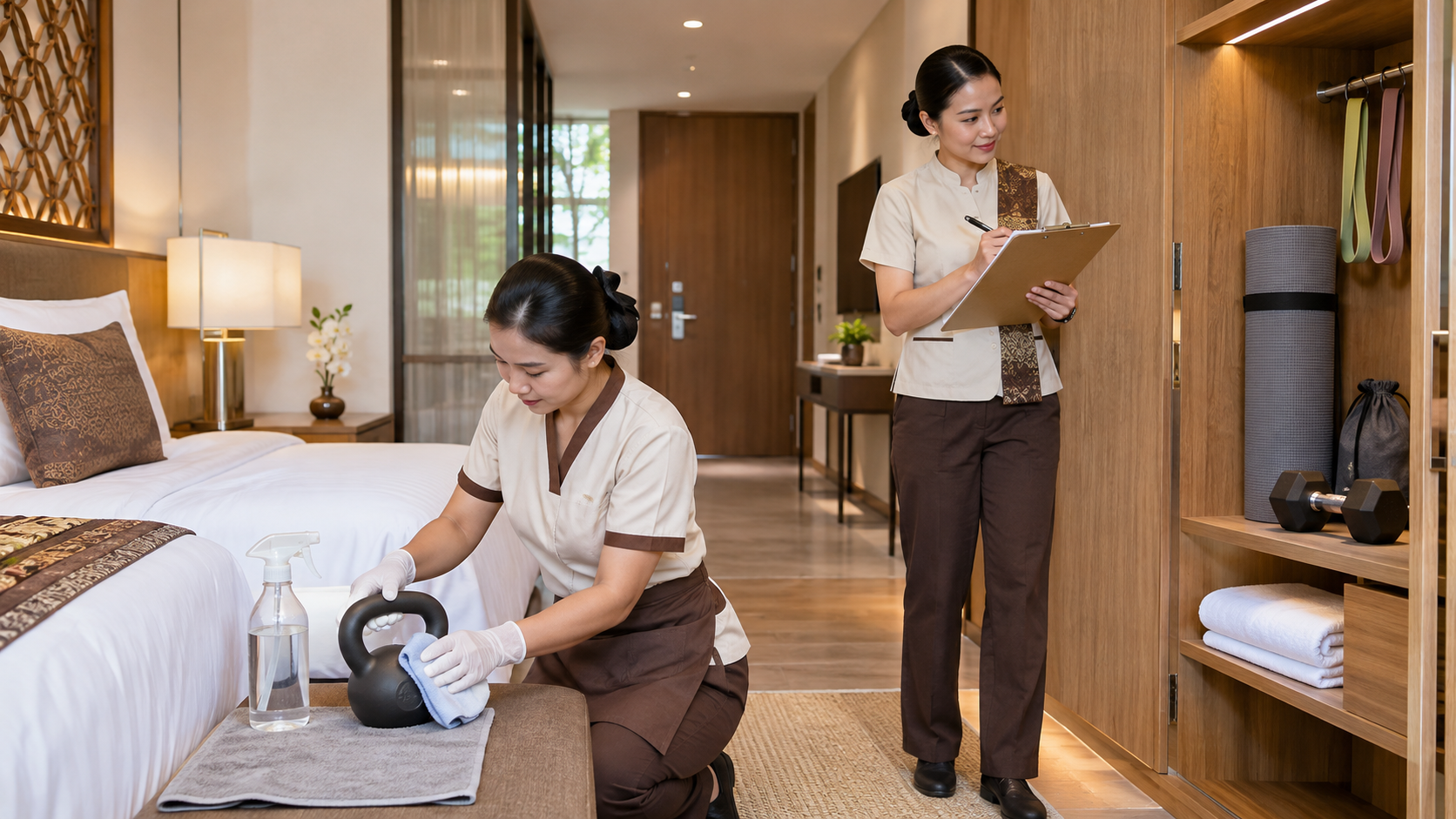
Housekeeping should co-design the standard because it owns the most frequent inspection. Define photographs or observable criteria for equipment position, count, condition, cleanliness, battery state and cable storage. Separate cleaning methods by material and follow manufacturer instructions for products and contact times.
Set a quarantine route for damaged or contaminated items. Do not ask attendants to make technical safety decisions outside their training. Measure the added reset time during real turnovers and include it in staffing and room-release planning.
5. Give engineering a preventive-maintenance route
Create an asset register with model, serial number, approved location, inspection frequency, responsible role and replacement parts. Define which faults remove one item and which faults take the whole room out of sale. A premium feature should not remain “temporarily unavailable” for weeks because ownership is unclear.
Test help requests after hours. Decide who can isolate power or water, who can move heavy equipment, and how the front desk relocates a guest when the core room promise has failed.
6. Protect choice, accessibility and privacy
Let guests opt out. Offer equipment removal or a standard room alternative where practical. Keep controls understandable and reachable, provide written and verbal help, and avoid scent, sound or light sequences that cannot be stopped. Accessibility should be reviewed with people who use the room, not inferred from a design drawing.
Collect the minimum data needed to deliver the service. A guest should not have to disclose health information merely to use a mat or change the light. If connected equipment records behaviour, explain what is collected, why, where it goes and how to use the feature without unnecessary tracking.
7. Rehearse incidents and service recovery
Run scenarios before launch: a guest reports pain, an item breaks, a cable is damaged, equipment is missing, a tutorial fails, a neighbour complains about noise, or a child enters the activity area. Staff need a stop rule, an escalation contact and a recovery option.
Incident records should distinguish equipment condition, user guidance, environmental factors and response. Do not turn the review into a search for guest fault. The purpose is to correct the system and decide whether the room can return to sale.
8. Approve the economics with total cost
Model the full room, not the purchase price. Include design, installation, training, added cleaning time, consumables, software, inspection, spare stock, maintenance, room downtime, support calls and replacement. Compare the result with actual rate premium, occupancy, satisfaction and repeat demand.
The site's analysis of hotel wellness investment and performance data explains why a wellness narrative should be separated from verified operating results. A property can value differentiation while still requiring a disciplined return case.
Pilot the operating model before a portfolio rollout
Start with a small number of rooms that represent real operating conditions. Include different floors or room shapes if those differences affect noise, ventilation, storage or staff travel. Do not select only the easiest rooms and assume the process will transfer unchanged.
A practical pilot has three stages. First, run staff-only rehearsals for arrival, explanation, reset, maintenance and recovery. Second, invite a limited guest group with clear feedback routes and no exaggerated claims. Third, sell the rooms normally while maintaining daily readiness review and a defined stop rule.
The soft-opening guide for training, testing and team readiness offers a useful rehearsal logic. For an in-room product, the test must include front office, housekeeping, engineering, digital, security and spa or wellness staff. A hand-off that works inside one department is not enough.
Measure readiness, use and value separately
- Readiness: reset pass rate, missing or damaged items, maintenance response, room-release delay and staff training status.
- Use: help requests, voluntary tutorial starts, equipment requests and abandonment, collected without intrusive surveillance.
- Guest response: clarity, ease, room comfort, complaints and satisfaction among users and non-users.
- Economics: realised rate difference, occupancy, cleaning and maintenance cost, downtime, refunds and recovery cost.
- Risk: near misses, incidents, noise complaints, privacy questions and repeated equipment faults.
Do not compress these into one vanity score. High tutorial use cannot excuse poor room readiness. A rate premium does not erase repeated safety faults. Low use may mean weak demand, but it may also reveal poor explanation, inaccessible design or the wrong guest segment.
Assign ownership across the guest journey
The room needs one accountable product owner, but delivery is shared. Commercial teams define the promise and truthful sales language. Front office confirms the booking and offers help. Housekeeping resets and observes. Engineering maintains and isolates faults. Wellness specialists review safe guidance. Security and management own escalation. Finance tests total cost and realised value.
Make the hand-offs visible. The existing guide to the spa front desk and guest journey is relevant because reception often becomes the translator between a designed experience and a guest's first practical question. Give that team enough training and authority to solve the problem without pretending to provide clinical advice.
Review the operating standard after every serious event, repeated question, design change or equipment update. A room manual is a controlled record of current practice, not a launch document that disappears once photography is complete.
Conclusion
A wellness hotel room is credible when the ordinary work is as considered as the visible feature. The guest receives a clear promise, a reliable baseline room, understandable guidance, meaningful choice and fast support. Staff receive a reset standard, maintenance route, escalation rule and evidence that the economics justify the extra complexity.
The 2026 evidence does not say that every hotel needs an exercise station, sauna or connected sleep product. It says that innovation creates value only when operations help guests access it. Build the system first, test it under real turnover pressure and expand only when the room remains safe, usable and worth choosing.
Practical quality check for Wellness Hotel Rooms: An Operations-First Standard
Digital topics are valuable when they remove friction from the guest journey and the team workflow. For this article, the test is simple: can a spa owner read "Wellness Hotel Rooms: An Operations-First Standard" and know what to check, what to improve and what result should change in the business? If the answer is vague, the topic needs to be translated into a concrete operating decision, not left as a broad marketing idea.
Use this topic as a short management review. Compare the current guest journey with the promise in the title, then look for gaps in booking data, response quality, system adoption, page clarity and operational handoffs. The strongest version of the article is the one that connects the idea to real rooms, real staff behavior, real booking steps and real follow-up after the visit.
Owner checklist
- Define the decision: write what the owner, manager or front desk should change after reading about Wellness Hotel Rooms: An Operations-First Standard.
- Check the evidence: collect the page, listing, menu, script, photo, review or operating report that proves the current situation.
- Protect the guest experience: make sure the change improves clarity, comfort, trust, timing or consistency for the client.
- Choose one measure: review booking accuracy, staff adoption, data completeness and time saved per workflow so the team can tell whether the improvement worked.
How NUAD SPA would apply it
NUAD SPA would treat Wellness Hotel Rooms: An Operations-First Standard as a focused workstream, not an isolated article topic. The first step is to map the current process, then decide whether the main blocker is positioning, service design, team execution, digital visibility, booking friction or retention. That diagnosis keeps the recommendation close to the title and avoids generic advice.
The next step is a two-week action sprint: update one public-facing touchpoint, brief the team on the new standard, test the booking or service flow, and collect feedback from staff and guests. This makes the article useful because it creates a next move, not only a point of view.
Risks to avoid
The common mistake is to make Wellness Hotel Rooms: An Operations-First Standard sound bigger than the spa can operationally support. A campaign can create demand the reception cannot answer; a new treatment can promise benefits the team has not been trained to deliver; a design trend can look attractive but reduce flow or profitability. The safer approach is to pair every idea with an owner, a checklist and a visible standard.
Frequently Asked Questions
What makes a hotel room a wellness room?
There is no single universal feature list. A credible wellness room has a defined guest promise, a reliable baseline environment, appropriate equipment or controls, understandable guidance, guest choice, safe operating boundaries and a repeatable reset and maintenance system.
Should every guest receive a wellness-room orientation?
Offer a concise explanation and help, but do not force a long orientation. The level of guidance should match the feature's complexity and risk. Guests should also have a simple self-guided route and the choice not to use the wellness elements.
Who should inspect in-room wellness equipment?
Housekeeping can perform frequent observable checks when trained, while technical inspections should remain with engineering, approved suppliers or other competent specialists. The standard should state exactly what each role may check and when an item must be quarantined.
How long should a wellness-room pilot run?
Long enough to include real turnovers, maintenance, different guest types and both busy and quiet demand. Use evidence-based exit criteria rather than a fixed promotional date. Do not scale while serious faults, inconsistent resets or unclear economics remain unresolved.
Which metrics matter most?
Track readiness, guest use, guest response, total economics and risk separately. The most useful measures include reset pass rate, help demand, faults, downtime, realised room-rate difference, incremental cost, complaints, near misses and satisfaction among both users and non-users.
Sources and References
- Crossref / SAGE — 2026 study of radical service innovation in wellness hospitality
- Global Wellness Institute — Initiative Trends 2026
- Hilton — Five Feet to Fitness room product
- Tourism Northern Ireland — Guidance Notes for Hotel Operators Quality Assurance
- Thailand Department of Thai Traditional and Alternative Medicine — Thainess Wellness Destination dataset and criteria summary
Need an operating audit for a hotel spa or wellness-room concept? Talk to NUAD SPA.