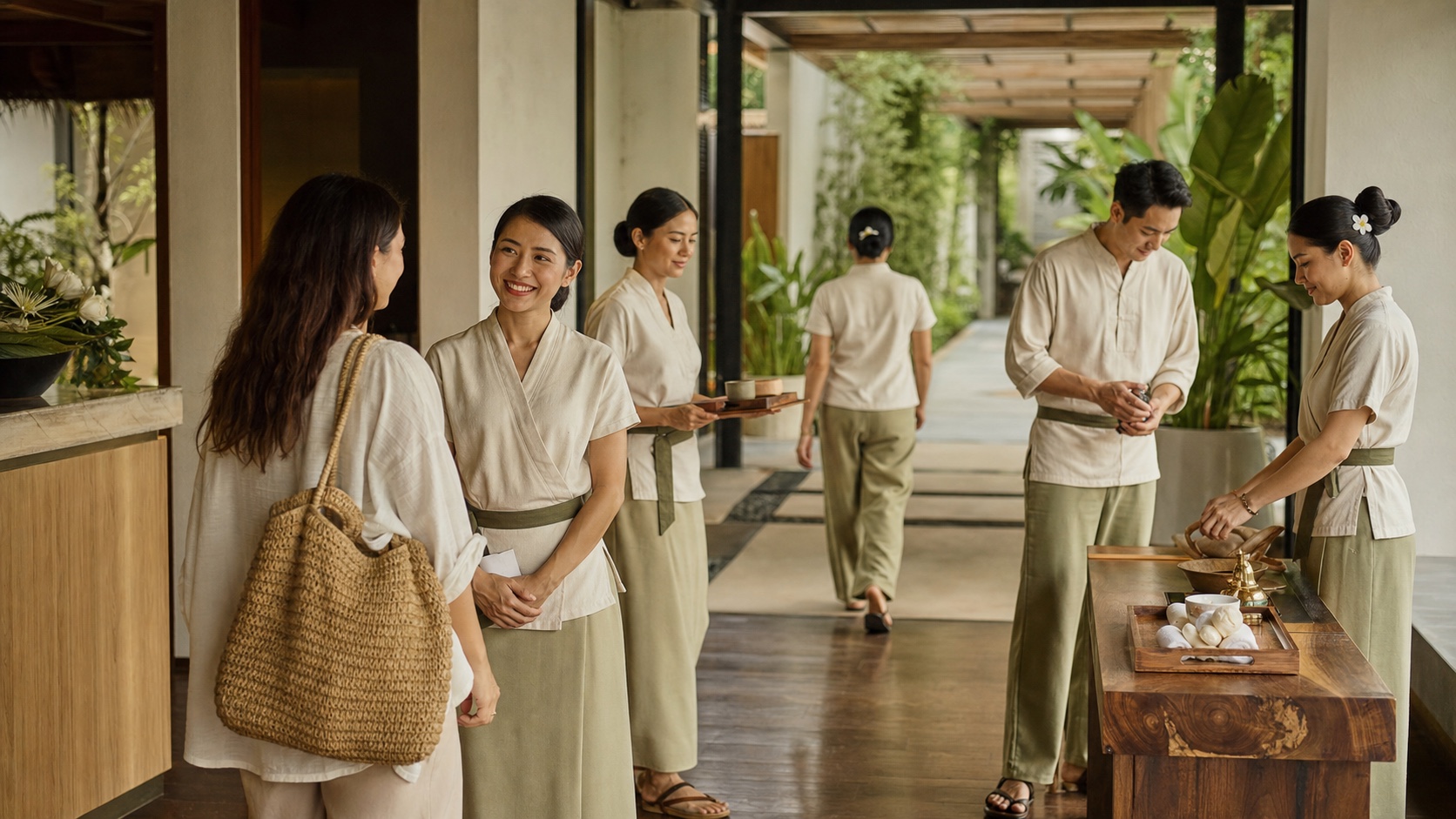
Thailand is building one of the world's most compelling wellness economies. Visitors can experience traditional Thai massage, destination retreats, medical-wellness programs, luxury resorts, urban spas and preventive health services at a scale few countries can match. Yet the next test of leadership is no longer only what Thailand can sell to the guest. It is whether the therapists, receptionists, trainers, nurses, managers and hospitality teams delivering that promise can build healthy, skilled and sustainable careers inside it.
Key takeaways
- Thailand's wellness economy reached US$42.7 billion in 2024, up 10.1% in one year. Wellness tourism spending reached US$14 billion after 36.4% annual growth, while the spa sector expanded by 18%.
- Market growth measures spending and activity. It does not, by itself, reveal whether the people delivering wellness have manageable workloads, adequate resources, effective managers or credible career paths.
- A Bangkok workforce survey found 12% of respondents experiencing burnout and another 57% at risk. This is a broad workforce signal, not a spa-sector prevalence estimate, but it exposes a risk that wellness operators cannot afford to ignore.
- The strongest response is operational: design workloads around real capacity, protect recovery, improve manager capability, create visible skills pathways, listen to employees and connect workforce metrics with guest and financial results.
- Thailand can become more than a wellness destination if employee wellbeing becomes part of service quality, investment policy, professional training and the national definition of wellness success.

The growth story is genuinely impressive
The latest Global Wellness Institute country data puts Thailand's wellness economy at US$42.71 billion in 2024, up from US$38.79 billion in 2023. That 10.1% annual increase placed Thailand seventh among the 25 largest wellness markets for growth. It was the world's 24th largest wellness economy and the ninth largest in Asia-Pacific. These are not marginal gains. They show that wellness has become a meaningful part of Thailand's economic identity.
Wellness tourism is the standout. Spending rose by 36.4% between 2023 and 2024 to reach US$14 billion, placing Thailand 15th worldwide in that sector. The growth rate was roughly three times the global average cited by GWI. Thailand's spa economy grew by 18%, while spending at destination spas and hotel or resort spas increased by more than 20% in the same year. Wellness real estate also expanded by 22.9%, suggesting that the category is moving beyond treatments into where people travel, recover and live.
The wider tourism platform gives those sectors extraordinary reach. The Tourism Authority of Thailand reported more than 35 million international arrivals in 2024 and tourism revenue above 1.8 trillion baht. Every arrival does not become a wellness guest, but the visitor base gives spas, resorts, clinics, retreats and hospitality brands a vast market. It also creates intense expectations around service, language, timing, cleanliness, safety and emotional warmth.
Thailand has another advantage that cannot be manufactured quickly: cultural authority. UNESCO inscribed Nuad Thai on the Representative List of the Intangible Cultural Heritage of Humanity in 2019. The inscription recognizes traditional Thai massage as an art, science and cultural practice within traditional healthcare, as well as an income-generating occupation supported by a formal system of knowledge. This matters commercially, but it matters even more as a reminder that the knowledge lives in people.
So the growth story is real. The opportunity is real. But market size answers only one question: how much economic activity is taking place? It does not answer a second and equally important question: what is happening to the workforce required to sustain it?

The missing line in most market reports
Wellness economies are usually measured through consumer spending. Researchers total the value of tourism, spas, preventive health, fitness, healthy eating, personal care, wellness real estate and related sectors. This is useful because it shows demand, scale and investment potential. But expenditure is an output measure. It says little about whether a therapist completes too many physically demanding treatments in succession, whether a receptionist absorbs guest frustration without support, or whether a supervisor has been trained to manage people rather than only schedules.
That creates a measurement gap. The guest experiences a polished product: a serene arrival, a warm welcome, a skilled treatment, a clean room, a thoughtful meal, an accurate health consultation and an effortless departure. Behind that calm surface is a labor system. It includes rotas, staffing ratios, breaks, room turnover, emotional labor, physical technique, supervision, pay, incentives, training, language demands, complaint recovery and career progression.
When the labor system is healthy, the guest promise becomes repeatable. When it is fragile, the operation depends on individual sacrifice. A resort may still look beautiful and a spa may still receive positive reviews for a time, but the hidden pressure eventually appears as resignation, absenteeism, rushed service, inconsistent technique, more complaints, weak rebooking and difficulty recruiting experienced people.
This is why wellbeing that a business sells but does not practise internally is branding, not a system. A wellness company does not need to eliminate every difficult day. Hospitality will always have peaks, demanding guests and operational surprises. The standard is whether the organization identifies predictable risks and designs work so people can recover, learn and perform without chronic overload.
What Thailand's workforce data actually tells us
The most widely quoted burnout figure comes from the College of Management at Mahidol University's "Burnout in the City" research. A survey of 1,280 working-age people in Bangkok classified 12% as experiencing burnout, 57% as at risk and 31% as having high energy or motivation. The finding was later summarized in the English-language Thai Health Report 2024.
The distinction matters: this was not a survey of spa therapists, hotel employees or wellness workers, and it should not be presented as if 69% of Thailand's wellness workforce is burned out. It is also an older Bangkok study, so it is best treated as a warning signal rather than a current sector estimate. What it does show is that burnout risk was already widespread in the urban labor market from which many wellness and hospitality businesses recruit.
Jobsdb by SEEK added a more recent employer view in 2024. Its Hiring, Compensation and Benefits research gathered data from 685 companies across industries and functions in Thailand. Fourteen percent of surveyed companies fell into the high-stress category. Employers identified heavy workload as the leading cause of workplace stress at 43%, followed by inadequate resources at 26% and pressure from management or fast-paced working conditions at 24%. Among high-stress organizations, 33% reported high resignation rates as a problem.
Again, these are cross-industry findings. They do not prove that every spa has the same pattern. They do identify the operating conditions that leaders should test inside their own businesses: too much work, too few resources, weak management and a pace that is not sustainable. Those risks are especially relevant in service businesses because the employee's physical presence, attention and emotional regulation are part of what the customer buys.
The global evidence strengthens the business case. The World Health Organization estimates that 15% of working-age adults have a mental disorder at any point in time and that depression and anxiety cost the global economy around US$1 trillion each year, mainly through lost productivity. WHO therefore recommends organizational interventions that change working conditions, alongside manager training, worker training, individual support, reasonable accommodations and meaningful employee participation.
Why wellness work can become unwell
Spa and hospitality work contains several forms of demand at the same time. The physical demand is obvious for massage therapists, movement specialists, nurses, beauty professionals and housekeeping teams. Repetitive pressure, standing, lifting, bending and sustained hand work require technique, conditioning and recovery. An elegant treatment may look gentle to the guest while requiring precise physical effort from the practitioner.
The emotional demand is less visible. Receptionists must stay calm when schedules slip. Therapists must create safety and presence even when they are tired. Managers absorb complaints, coordinate absent staff and protect the guest from operational complexity. In medical-wellness settings, teams also manage sensitive health information, informed consent, risk and high client expectations.
Demand is also uneven. Resort occupancy, flight schedules, weekends, holidays, weather and group bookings can create sharp peaks. If staffing is based only on average demand, the busiest periods become chronically understaffed. If the operator responds by keeping too many people on standby during quiet periods, income can become unpredictable and morale can fall for a different reason. Good workforce design must balance guest demand, employee income, physical capacity and the economics of the business.
Finally, much of the work is invisible in productivity reports. A therapist's day includes consultation, setup, cleaning, notes, product preparation, handover and emotional reset, not only paid treatment minutes. A receptionist's contribution includes reassurance, language support, error prevention and relationship memory, not only transactions. When managers measure only booked hours or sales, they risk removing the time that makes those outcomes possible.

Five hidden workforce costs behind a beautiful guest experience
1. Turnover resets the learning curve
Recruitment is only the visible cost of resignation. The deeper cost includes practical testing, onboarding, trainer time, lower initial utilization, inconsistent treatment rhythm, lost guest relationships and additional pressure on experienced colleagues. If turnover becomes normal, the organization keeps paying to rebuild competence it already paid to develop.
2. Presenteeism reduces service precision
An employee can be physically present and still lack the concentration or energy required for premium care. In a spa, the result may be a missed preference, a shorter consultation, less confident product advice or a rushed reset. The financial effect is dispersed across lower rebooking, service recovery and average spend, which makes it easy to miss in a monthly cost report.
3. Physical fatigue reduces usable capacity
A treatment hour is not infinitely repeatable. Different services place different loads on hands, shoulders, back and attention. A schedule with six demanding massages in a row is not equivalent to a balanced day with varied treatments and real transition time. When capacity planning ignores treatment intensity, the rota may look efficient while quality and safety deteriorate.
4. Weak career paths turn experience into an exit
Skilled employees need a reason to stay beyond next month's schedule. Progression can include senior therapist levels, trainer roles, specialist techniques, quality assurance, guest-experience leadership, retail education or spa management. Without visible paths, the most capable people may leave to find growth elsewhere or abandon the sector entirely.
5. Manager overload multiplies every other problem
Managers who spend all day replacing absent staff, fixing booking errors and calming conflicts have little time for coaching, pricing, partnerships or improvement. Their overload becomes an organizational bottleneck. A wellness business can therefore grow revenue while becoming less capable, because every new guest adds work to a system that has not developed.
Build a people-first wellness operating system
The answer is not a collection of occasional wellness perks. Yoga classes, snacks, outings and counseling access can be useful, but they cannot compensate for a permanently understaffed rota or an abusive supervisor. WHO's guidance is clear that prevention begins with organizational interventions: assess risks and modify the work environment itself.
For a spa, resort or wellness center, that means five connected management disciplines.
- Workload design: schedule against real demand, define maximum treatment intensity, include setup and reset time, protect meal and recovery breaks, and avoid rewarding managers only for keeping labor hours low.
- Recovery and safety: train ergonomic technique, rotate demanding services, provide appropriate equipment, track discomfort and incidents early, and make recovery part of capacity planning rather than a private employee problem.
- Manager capability: train supervisors in communication, feedback, conflict, recognition, psychological safety and the relationship between job design and mental health.
- Career and skills: publish skills matrices, pay for relevant learning, create transparent progression and recognize the cultural and technical expertise carried by experienced practitioners.
- Voice and metrics: use short pulse checks, one-to-one conversations, exit analysis and operational data; then show employees what changed because they spoke.


Three practical operating examples
The following scenarios are illustrative, not claims about named companies. They show how the same principle changes across different wellness models.
A luxury resort spa
A resort may experience demand spikes after guest check-in, during poor weather and before dinner. The weak response is to keep a lean fixed team and ask everyone to extend shifts when bookings surge. A stronger model forecasts demand from occupancy, arrival patterns and historical treatment mix. It adds trained flexible capacity for predictable peaks, limits consecutive high-intensity treatments and protects one supervisor from a full treatment load so that service recovery and team support remain available.
An urban day spa
An urban spa may be quiet in the afternoon and full from 5 p.m. to 10 p.m. or on weekends. The weak response is a long shift with low paid productivity early and intense pressure late. A stronger model combines voluntary staggered shifts, transparent earnings, off-peak membership benefits and a menu designed for different time windows. Employees understand the rota in advance, and the business improves utilization without turning every evening into an emergency.
A medical-wellness center
A medical-wellness operation has additional cognitive and compliance load. Staff may coordinate diagnostics, consultations, consent, lifestyle programs and sensitive follow-up. The weak response is to measure only appointment volume. A stronger model allocates protected time for documentation and handover, creates escalation rules, trains managers in psychological safety and reviews near misses without blame. The result supports both patient confidence and workforce resilience.
The economics of investing in people
Employee wellbeing is sometimes treated as a moral ambition separated from commercial performance. In reality, the connection can be measured. The simplest turnover formula is: avoided departures multiplied by recruitment, onboarding, training, lost contribution and service-recovery cost. Operators should use their own numbers rather than a generic benchmark.
Consider a hypothetical spa with 20 therapists. Reducing annual turnover from 30% to 20% would mean two fewer departures. If the operator estimates direct hiring and onboarding cost at 45,000 baht per person, the immediate saving is 90,000 baht. That figure still excludes the treatment capacity lost while a new hire learns the menu, the senior trainer's time and any guest relationships that move with the departing therapist. This is an example calculation, not a Thailand industry benchmark, but it shows why retention deserves a place in the profit model.
Capacity can be priced in the same way. Recovering one bookable room-hour per day at an average realized treatment value of 1,800 baht across 300 operating days represents 540,000 baht in annual revenue opportunity before variable costs. The opportunity is only real if demand exists and the workforce can deliver safely. That is exactly the point: room utilization and employee capacity must be planned together.
A useful leadership dashboard should therefore connect people, guest and financial indicators rather than isolate them.
- People: voluntary turnover, absence, overtime, break completion, schedule changes, training hours, internal promotions and employee pulse scores.
- Operations: treatment intensity by shift, therapist utilization, room utilization, on-time starts, reset time and manager coverage.
- Guest: rebooking, repeat visits, complaints, service recovery, review themes and consistency by day or shift.
- Economics: revenue per available treatment hour, contribution margin by service, average ticket, retail conversion and cost of turnover.
The objective is not surveillance. Data should help leaders see system pressure early. Individual metrics must be handled fairly, with context and privacy. A therapist with lower volume may be carrying more complex guests, training colleagues or delivering longer high-intensity services. Numbers should begin a management conversation, not replace judgment.

What a national wellness workforce agenda could include
Individual employers carry the first responsibility for their working conditions, but Thailand's opportunity is larger than one company at a time. A true wellness nation would treat workforce quality as infrastructure, just like airports, clinics, hotels and destination marketing.
First, training credentials should be credible, portable and connected to career levels. The cultural safeguarding of Nuad Thai should include the people who hold and transmit the knowledge, not only the use of Thai massage as a tourism image. Experienced practitioners should have routes into assessment, teaching, quality assurance and leadership.
Second, manager development should become a sector priority. Many excellent therapists or receptionists are promoted because they are technically strong, then asked to lead without training. A national service advantage depends on supervisors who can plan capacity, coach performance, prevent harassment, communicate fairly and respond to mental-health concerns appropriately.
Third, industry reporting should include workforce indicators. Market reports celebrate openings, spending and visitor growth. Operators, associations and policymakers could also track vacancies, retention, training participation, career progression and employee wellbeing with appropriate privacy. What gets measured becomes easier to manage.
Fourth, hotel owners, investors and wellness brands should include workforce standards in procurement and development decisions. A new spa concept is not complete when the rooms and menu are approved. The feasibility model should test staffing availability, realistic payroll, training time, supervisor capacity, service intensity and accommodation or transport needs where relevant.
Finally, Thailand should treat good work as part of destination quality. A guest may never see the rota or the training budget, but they feel the result. Stable, respected teams remember preferences, improve their craft and create the calm confidence that premium wellness depends on.
A practical 90-day plan for wellness operators
Days 1 to 30: establish the truth
Map demand by hour, day and treatment type. Review overtime, shift changes, absence, turnover, complaints and exit reasons. Hold confidential conversations with therapists, reception, housekeeping and managers. Ask what creates avoidable pressure, what resources are missing and which parts of the work are not visible in the schedule.
Days 31 to 60: redesign one pressure point
Choose one issue with measurable impact: consecutive high-intensity treatments, late rota publication, inadequate reset time, poor manager coverage or weak handovers. Test a new standard with the team. Link the change to guest and business outcomes so it is not dismissed as an isolated HR initiative.
Days 61 to 90: make the system repeatable
Document the new process in the spa SOP, train supervisors, define the dashboard and schedule a monthly workforce-capacity review. Connect the findings with staff training, recruitment and onboarding, pricing and the treatment menu. Improvement lasts when it belongs to operations, not only to a campaign.
Can Thailand become a true wellness nation?
Thailand does not need to choose between commercial growth and employee wellbeing. The two are increasingly dependent on each other. A US$42.7 billion wellness economy cannot remain world class through architecture, marketing and treatment innovation alone. It needs people who have the time, skill, support and career confidence to deliver what the country promises.
The next chapter should therefore be measured in more than new resorts, clinics, residences and visitor spending. It should also be measured in stronger managers, safer workloads, respected expertise, lower avoidable turnover and careers that become more valuable with experience.
Thailand's greatest wellness asset is not only its hotels, treatments or infrastructure. It is its people. Protecting that asset is not separate from growth. It is how the growth becomes durable.
Practical quality check for Thailand's Wellness Boom: Who Is It Really Working For?
People topics only matter when they change daily behavior. For this article, the test is simple: can a spa owner read "Thailand's Wellness Boom: Who Is It Really Working For?" and know what to check, what to improve and what result should change in the business? If the answer is vague, the topic needs to be translated into a concrete operating decision, not left as a broad marketing idea.
Use this topic as a short management review. Compare the current guest journey with the promise in the title, then look for gaps in training records, service observations, therapist confidence and guest feedback. The strongest version of the article is the one that connects the idea to real rooms, real staff behavior, real booking steps and real follow-up after the visit.
Owner checklist
- Define the decision: write what the owner, manager or front desk should change after reading about Thailand's Wellness Boom: Who Is It Really Working For?.
- Check the evidence: collect the page, listing, menu, script, photo, review or operating report that proves the current situation.
- Protect the guest experience: make sure the change improves clarity, comfort, trust, timing or consistency for the client.
- Choose one measure: review booking accuracy, staff adoption, data completeness and time saved per workflow so the team can tell whether the improvement worked.
How NUAD SPA would apply it
NUAD SPA would treat Thailand's Wellness Boom: Who Is It Really Working For? as a focused workstream, not an isolated article topic. The first step is to map the current process, then decide whether the main blocker is positioning, service design, team execution, digital visibility, booking friction or retention. That diagnosis keeps the recommendation close to the title and avoids generic advice.
The next step is a two-week action sprint: update one public-facing touchpoint, brief the team on the new standard, test the booking or service flow, and collect feedback from staff and guests. This makes the article useful because it creates a next move, not only a point of view.
Risks to avoid
The common mistake is to make Thailand's Wellness Boom: Who Is It Really Working For? sound bigger than the spa can operationally support. A campaign can create demand the reception cannot answer; a new treatment can promise benefits the team has not been trained to deliver; a design trend can look attractive but reduce flow or profitability. The safer approach is to pair every idea with an owner, a checklist and a visible standard.
Frequently asked questions
How large is Thailand's wellness economy?
Global Wellness Institute data values Thailand's wellness economy at US$42.7 billion in 2024, up 10.1% from 2023. Thailand ranked 24th globally by market size and ninth in Asia-Pacific.
How fast is wellness tourism growing in Thailand?
Wellness tourism spending reached US$14 billion in 2024 after 36.4% growth between 2023 and 2024. GWI ranked Thailand 15th worldwide for wellness tourism.
Do the burnout figures apply specifically to spa workers?
No. The 12% burnout and 57% at-risk figures come from a survey of 1,280 working-age people in Bangkok. They are useful as a broad workforce warning, but they should not be described as spa-sector prevalence data.
What should a spa measure to protect employee wellbeing?
Start with turnover, absence, overtime, schedule changes, break completion, treatment intensity, utilization, training, internal progression and short confidential pulse checks. Review those alongside rebooking, complaints, service consistency and contribution margin.
What is the first operational change a spa should make?
Map workload by hour and treatment intensity, then ask employees where predictable pressure is created. Redesign one concrete issue, such as consecutive demanding treatments or inadequate reset time, and measure the effect before expanding the approach.
Need to align workforce design, service standards and sustainable spa growth? Talk to NUAD SPA.