Thailand’s latest tourism positioning offers spa operators an unusually clear challenge. “Healing is the New Luxury” is not a treatment name or a licence to promise cures. It is a proposition that travel can feel restorative when wellness, culture, nature and thoughtful hospitality work as one coherent journey. The commercial opportunity is real, but only if the destination message becomes a service that guests can understand, book and trust.
On 25 September 2026, the Tourism Authority of Thailand reported that it was presenting this concept at Tourism Expo Japan 2026. TAT combined wellness with cultural demonstrations, local craft and responsible tourism, and identified Japanese interest in culture, nature and deeper destination experiences. It also reported an average stay of 7.74 days and average expenditure of 40,497.38 baht per Japanese visitor to Thailand. Those figures describe a market signal, not a guaranteed demand forecast for any individual spa.
The operating question is therefore more useful than the slogan: what would make a healing-led Thai spa experience specific, culturally credible and worth adding to a trip? This playbook sets out a practical answer, from concept and claims to delivery, partnerships, market adaptation and measurement.
Key takeaways
- Translate “healing” into a defined guest need and a credible service pathway; never treat the word as a medical outcome claim.
- Build the experience around living Thai knowledge, skilled people and place—not decorative references added after the menu is written.
- Create a sequence with a clear beginning, middle and end, including preparation, treatment, rest, interpretation and a simple take-home practice.
- Make the offer easy to buy through transparent duration, inclusions, suitability, language support, price and transport information.
- Measure guest understanding, delivery consistency, local benefit and repeat demand as well as revenue.
Start with the promise, then narrow it
TAT’s wider description of “Healing is the New Luxury” spans medical care, traditional practice, personalised recovery and nature-based wellness. That breadth works for national destination marketing. A spa product needs a much narrower promise because staff must deliver it consistently and guests must know what they are buying.
Begin by naming one primary guest need. It might be decompression after a long flight, quiet reconnection for a couple, physical ease after an active itinerary, or a culturally grounded introduction to Thai wellness. Avoid a menu that claims to deliver sleep repair, detoxification, emotional healing, pain treatment and longevity in one package. A focused outcome is easier to explain, staff and evaluate.
Then write a controlled promise in ordinary language. “A half-day Thai wellness journey designed to help guests slow down and feel restored” is a hospitality proposition. “Repairs the nervous system” or “heals chronic stress” is a medical-style claim that requires a very different evidence, professional and regulatory basis. The word healing in a campaign theme does not remove an operator’s duty to use accurate claims.
The controlled promise should appear in the concept brief, treatment menu, booking page, partner description and staff script. If sales teams, therapists and travel agents describe different outcomes, the product is not ready.
Build the product from Thai knowledge, not Thai decoration
Cultural value comes from knowledge, practice and people. UNESCO inscribed Nuad Thai on the Representative List of the Intangible Cultural Heritage of Humanity in 2019, describing it as part of the art, science and culture of traditional Thai healthcare and noting the communities and practitioners through which knowledge is transmitted. The inscription is not a marketing badge for any massage that uses Thai imagery. It is a reason to treat the tradition, its practitioners and its context with care.
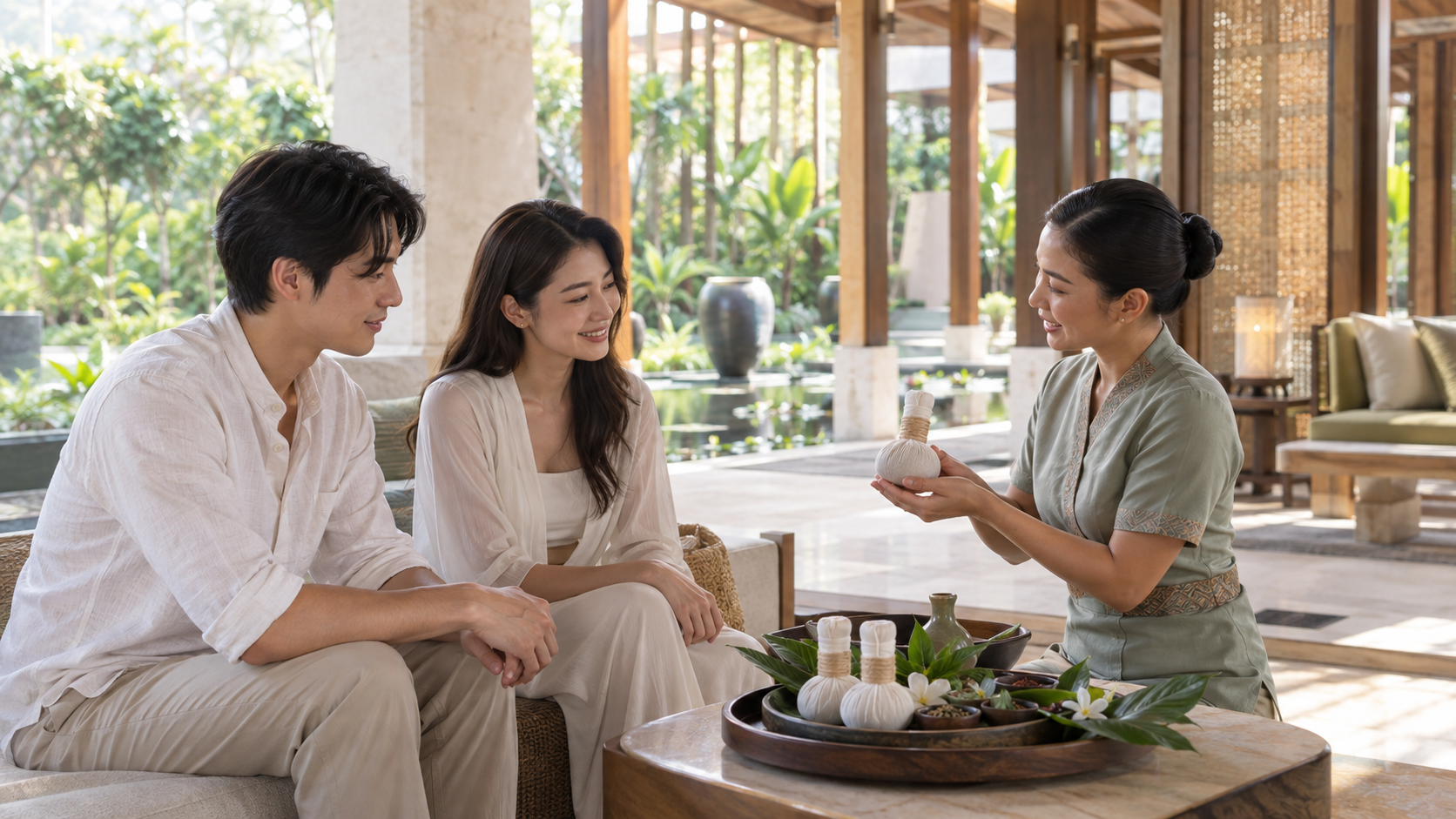
For each cultural element, document who supplied the knowledge, who is qualified to deliver it, how it is explained, and how the provider or community benefits. A herbal compress, for example, should not be reduced to a photogenic prop. The team should know its ingredients, sourcing, preparation, heat controls, contraindications, service role and disposal method. If a local maker or practitioner contributes, the commercial relationship should be explicit and fair.
Interpretation should be concise and accurate. Guests do not need a lecture during a treatment, but they should understand what they are experiencing and why it belongs in this place. Avoid invented legends, generic “ancient secrets” and claims that turn living culture into fantasy. Where regional traditions differ, name the region and source rather than presenting one version as universal.
This discipline also protects differentiation. A competitor can copy a treatment duration or scent profile. It is harder to copy trusted local relationships, well-trained practitioners and an experience built around a coherent sense of place.
Design a journey rather than a bundle
A healing-led offer becomes memorable through sequence. Adding tea, massage and meditation to a package does not automatically create a journey. Each stage should prepare for the next and manage the guest’s physical and emotional load.
1. Arrival and orientation
Reduce uncertainty before asking the guest to relax. Confirm the schedule, privacy level, clothing, practitioner, suitability questions and any choices. Explain the cultural elements without overloading the first five minutes. For international visitors, transport and arrival instructions are part of the service, not an administrative afterthought.
2. Transition
Create a short change of pace between travel and treatment. This may be quiet tea, breathing, warm foot cleansing or a garden pause. The action should be comfortable, optional where appropriate and operationally realistic. A transition that routinely makes appointments start late will undermine the whole experience.
3. Core practice
Choose one main treatment or guided activity and protect the time required to deliver it well. Match pressure, temperature, movement and sensory intensity to the guest rather than forcing everyone through a signature choreography. Clear consultation and consent remain premium behaviours.
4. Integration and rest
Do not end an intensive treatment with a rushed payment request. Allow a defined period for rest, hydration and simple guidance. If the package includes a craft, nature walk or food element, consider whether it supports the intended pace or turns restoration into a crowded itinerary.
5. Continuity
Give the guest one realistic practice to carry forward: a short mobility sequence, a breathing cue, a bathing ritual or a sourcing note about a local product. Avoid long generic handouts. The aim is recall and usefulness, not proving how much content was produced.
Operators developing the core treatment can use the existing guide to signature spa treatments, while the nature-positive experience playbook helps test outdoor and conservation-linked components.
Make responsible tourism visible in the operating model
The fresh TAT campaign connects wellness with culture, local knowledge and responsible tourism. Those ideas need records and decisions, not just language. The Global Sustainable Tourism Council’s Tour Operator Standard organises responsible practice around effective management, local social and economic benefit, cultural heritage and reduced environmental impact. It is a useful design reference, although reading the standard does not itself constitute certification.
Map where the product’s money and impacts go. Record the share spent with local practitioners, makers, growers and transport providers. Review whether employment and training opportunities reach local people. Check water, energy, laundry, single-use materials and waste generated per booking. If the experience enters a natural or culturally sensitive setting, define group size, timing, behaviour and community approval.
A responsible offer should also protect the people delivering it. A national wellness narrative will not survive inconsistent schedules, unpaid preparation or physical overload. The existing analysis of Thailand’s wellness growth and workforce wellbeing explains why therapist capacity, recovery and retention belong in commercial planning.
Make one person accountable for the impact file. Partnerships, sourcing, staff hours, incidents and guest feedback should be reviewed together, because a beautiful experience can still fail if it extracts value from the people or place that give it meaning.
Adapt for Japanese travellers without stereotyping
The Tourism Expo Japan announcement provides several useful facts: TAT is connecting wellness with culture, nature and deeper local experience; it sees potential in both independent and group travel; and it recognises price pressure from higher airfares, fuel surcharges and a weaker yen. It also reports an average Thai stay of 7.74 days for Japanese visitors. These are planning inputs, not permission to assume that every Japanese guest wants the same treatment, language style or schedule.
Use the evidence to improve choice and clarity. Offer a compact entry product that fits a Bangkok stop, a half-day version for resort itineraries and a deeper version that can connect with a secondary destination or local maker. Show exactly what is included, the total time on site and which parts are optional. Publish current prices and cancellation terms. If transport is complex, include a map pin, landmark, travel estimate and contact method that works for an international number.
Language support should cover the moments where misunderstanding creates risk: suitability questions, consent, pressure and temperature preferences, allergies, post-treatment advice and emergency contact. A translated menu is not enough if the practitioner cannot confirm whether the guest wants lighter pressure or needs the treatment to stop. Use trained interpreters or carefully tested tools for critical exchanges, and maintain a simple escalation path.
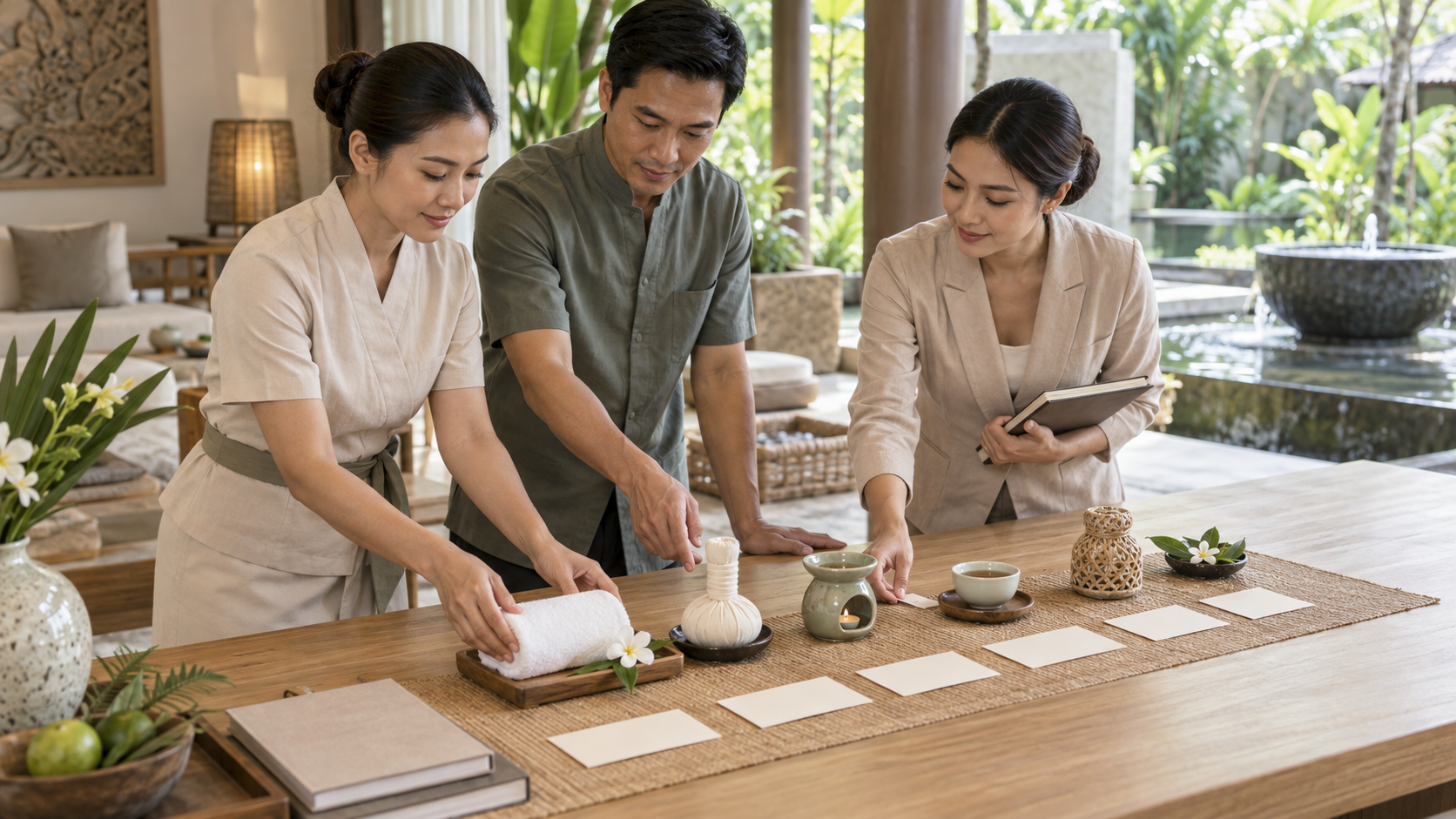
Test the product with varied guests and trade partners rather than relying on cultural assumptions. Include first-time and repeat visitors, different ages, independent travellers and group organisers. Ask what was unclear, what felt rushed, which cultural explanation mattered and whether the price matched the perceived value.
Turn the concept into a sellable product card
Before launch, require a one-page product card with the following fields:
- Guest need: the single primary need the experience is designed to support.
- Controlled promise: the approved non-medical description used across channels.
- Journey map: arrival, transition, core practice, rest and continuity, with minutes assigned.
- Cultural basis: practitioners, knowledge sources, explanation and benefit-sharing arrangement.
- Suitability: contraindications, accessibility, privacy choices and escalation rules.
- Delivery system: staffing, room, equipment, preparation, reset time and daily capacity.
- Commercial structure: price, commission, variable cost, contribution, cancellation and minimum viable demand.
- Impact controls: local purchasing, labour load, water, energy, laundry, waste and sensitive-site limits.
- Market readiness: language, booking, payment, transport, group handling and trade assets.
- Evidence: approved claims, source dates and the next review date.
Run a timed rehearsal with the same staffing and room reset expected in service. Then conduct a small paid pilot rather than a free showcase. Payment tests whether the proposition is genuinely understandable and valuable; the pilot tests timing, handovers, material use and guest comfort. The team should complete role-based rehearsal through a formal staff training process before wider distribution.
Measure value without manufacturing proof
Revenue matters, but it cannot be the only test. Track enquiry-to-booking conversion, average lead time, channel and partner mix, contribution per occupied treatment hour, cancellation rate, add-on rate and repeat or referral behaviour. Compare results by product version rather than blending a two-hour treatment with a full-day journey.
Service measures should include on-time starts, completed suitability checks, guest understanding, preference accuracy, incidents, recovery time between bookings and practitioner workload. Cultural and local-benefit measures can include the proportion of relevant purchasing that stays locally, partner payments made on time, training hours and feedback from contributing practitioners or communities.
Ask guests about the promise you actually made. Did the journey feel coherent? Did they understand the cultural context? Did they feel free to adjust or decline elements? Which part would they remember or recommend? Do not turn a short satisfaction survey into evidence that the product cured stress, improved a condition or delivered lasting health outcomes.
Review the complete product quarterly. Remove elements that add complexity without value, update source and partner information, check claims, and revisit price as labour and material costs change. Healing-led luxury should become more precise with experience, not accumulate more activities.
A 60-day route from campaign to service
Days 1–15: define and source
Select the guest need, controlled promise and target itinerary. Identify the cultural knowledge and local partners required. Check service scope, claims, practitioner qualifications, suitability and privacy needs. Reject any element that exists only because it photographs well.
Days 16–35: design and cost
Map the journey minute by minute, including preparation and reset. Build the product card, calculate contribution at realistic capacity, document sourcing and impact controls, and prepare the booking information in the required languages. Confirm transport and partner handovers.
Days 36–60: rehearse and pilot
Train the team, run timed scenarios and test critical language exchanges. Deliver a limited paid pilot, collect guest and practitioner feedback, close safety or timing issues and approve the final channel descriptions. Expand distribution only when delivery matches the promise.
Conclusion
“Healing is the New Luxury” gives Thai spa businesses a strong destination narrative, but a narrative is not yet a product. Operators create value when they narrow the promise, respect living knowledge, design an intelligible journey, support local people, communicate clearly and measure what they can honestly prove.
The most defensible form of luxury is not a longer menu or more dramatic claim. It is care made visible through preparation, skilled delivery, cultural integrity and an experience that fits the guest’s trip without losing its connection to place.
Practical quality check for Healing-Led Luxury: A Thai Spa Product Playbook
Digital topics are valuable when they remove friction from the guest journey and the team workflow. For this article, the test is simple: can a spa owner read "Healing-Led Luxury: A Thai Spa Product Playbook" and know what to check, what to improve and what result should change in the business? If the answer is vague, the topic needs to be translated into a concrete operating decision, not left as a broad marketing idea.
Use this topic as a short management review. Compare the current guest journey with the promise in the title, then look for gaps in booking data, response quality, system adoption, page clarity and operational handoffs. The strongest version of the article is the one that connects the idea to real rooms, real staff behavior, real booking steps and real follow-up after the visit.
Owner checklist
- Define the decision: write what the owner, manager or front desk should change after reading about Healing-Led Luxury: A Thai Spa Product Playbook.
- Check the evidence: collect the page, listing, menu, script, photo, review or operating report that proves the current situation.
- Protect the guest experience: make sure the change improves clarity, comfort, trust, timing or consistency for the client.
- Choose one measure: review booking accuracy, staff adoption, data completeness and time saved per workflow so the team can tell whether the improvement worked.
How NUAD SPA would apply it
NUAD SPA would treat Healing-Led Luxury: A Thai Spa Product Playbook as a focused workstream, not an isolated article topic. The first step is to map the current process, then decide whether the main blocker is positioning, service design, team execution, digital visibility, booking friction or retention. That diagnosis keeps the recommendation close to the title and avoids generic advice.
The next step is a two-week action sprint: update one public-facing touchpoint, brief the team on the new standard, test the booking or service flow, and collect feedback from staff and guests. This makes the article useful because it creates a next move, not only a point of view.
Risks to avoid
The common mistake is to make Healing-Led Luxury: A Thai Spa Product Playbook sound bigger than the spa can operationally support. A campaign can create demand the reception cannot answer; a new treatment can promise benefits the team has not been trained to deliver; a design trend can look attractive but reduce flow or profitability. The safer approach is to pair every idea with an owner, a checklist and a visible standard.
Frequently Asked Questions
Can a spa use “healing” in its product name?
It can use the term only with careful attention to local law and the complete context. The description should not imply diagnosis, treatment or cure unless the service, evidence and professional framework support that claim. A controlled hospitality promise such as restoration or reconnection is usually clearer.
Does UNESCO recognition certify an individual Thai massage service?
No. UNESCO’s 2019 inscription recognises Nuad Thai as intangible cultural heritage; it does not certify a particular spa, therapist or treatment. Operators still need qualified practitioners, accurate interpretation and appropriate local compliance.
How long should a healing-led spa journey be?
There is no universal duration. The journey should allow enough time for orientation, the core practice, rest and a calm close without creating unnecessary complexity. Operators can develop compact, half-day and deeper versions, provided each has a complete and credible sequence.
How should a spa adapt the offer for Japanese guests?
Start with clear inclusions, total duration, price, transport, suitability information and dependable language support. Test with varied Japanese travellers and trade partners, and preserve individual choice rather than designing from stereotypes.
What should operators measure first?
Begin with guest understanding, on-time and consistent delivery, suitability checks, practitioner workload, contribution per treatment hour, local partner value and verified repeat or referral behaviour. These measures show whether the product works without inventing health outcomes.
Sources and References
- Tourism Authority of Thailand — Healing is the New Luxury at Tourism Expo Japan 2026
- Tourism Authority of Thailand — Thailand redefines health and wellness tourism
- Tourism Authority of Thailand — Amazing Thailand Health and Wellness Trade Meet 2026
- UNESCO — Nuad Thai, traditional Thai massage
- Global Sustainable Tourism Council — Tour Operator Standard
Need to turn this diagnosis into an action plan? Talk to NUAD SPA.