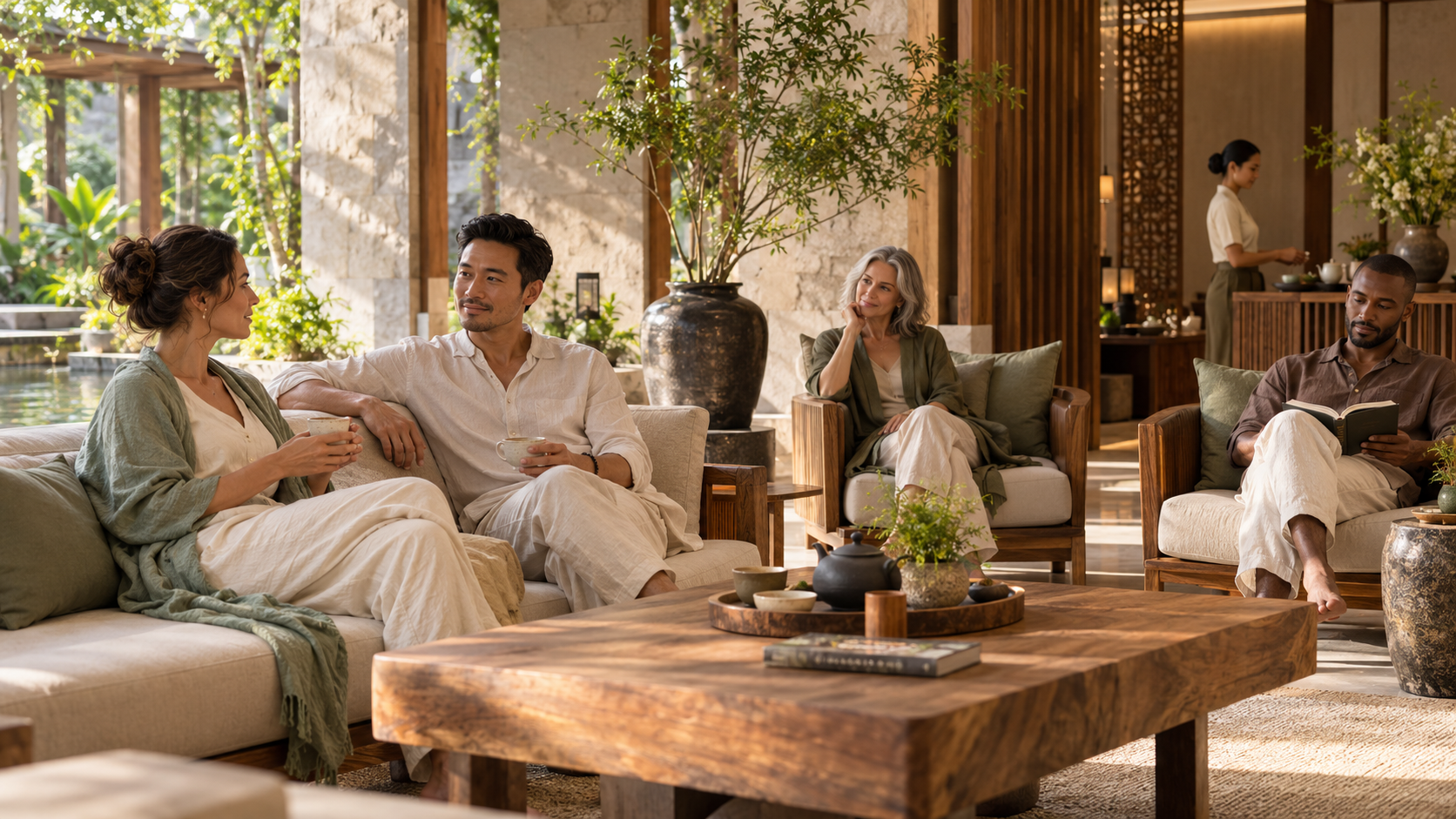
Social wellness is moving from a vague promise of togetherness into a practical hospitality question. Guests may want conversation, shared ritual or a sense of belonging, but they may also want silence, privacy or distance. A spa that treats connection as compulsory can undermine the calm it hopes to create. A spa that designs only for solitude can miss a form of value that current travel research increasingly identifies.
The operating opportunity is therefore not to make every treatment social. It is to give guests legible choices: solo, shared and lightly guided experiences, each supported by consent, appropriate space, trained hosts and clear boundaries. That approach can add warmth without turning a spa into a networking event or implying that hospitality can treat loneliness.
Key takeaways
- Social wellness should expand guest choice, not replace privacy or make participation feel compulsory.
- Design solo, shared and guided versions of the experience before promoting community as a benefit.
- Use hosts to reduce uncertainty, explain etiquette and protect boundaries rather than manufacture intimacy.
- Separate hospitality outcomes such as comfort, clarity and belonging from clinical claims about loneliness or mental health.
- Measure opt-in, opt-out, comfort, incidents, repeat demand and operating load before scaling the programme.
Why social wellness deserves its own service design
Spas have traditionally made privacy part of the value proposition. Quiet corridors, individual treatment rooms and low-contact recovery areas help guests step away from demands. That remains important. Social wellness adds another option: carefully hosted experiences in which people can share warmth, water, tea, movement, silence or reflection without being pushed into personal disclosure.
The distinction matters because social connection is not simply the number of people in a room. The 2025 report of the World Health Organization Commission on Social Connection defines connection through the ways people relate and interact, while distinguishing loneliness—the painful gap between desired and actual connection—from objective social isolation. WHO reports that about one in six people worldwide is affected by loneliness, but it does not suggest that a spa visit is a treatment. For operators, the responsible implication is narrower: environments and services can either make respectful interaction easier or create additional barriers.
Recent travel research points in the same direction. Hilton's 2027 Trends Report, based on a survey of 14,744 intended travellers across 14 countries, found that 60% were more drawn to water-based wellness experiences when they could share them with others. The report also found stronger trust in hotel staff than in AI for travel planning. These are stated preferences from brand-commissioned research, not a forecast of bookings at every property. They nevertheless suggest that human hosting and shared experience deserve deliberate design.
Read the evidence with its limits intact
Accor and Globetrender's Experiential Travel Trends 2026 used a Dynata survey of 4,300 travellers in nine countries. It reported that 84.5% always or often seek deeper in-person connection in their free time or while travelling, while 59% associated wellbeing with shared moments. The report labels social wellness as a current travel trend and gives examples of communal bathing, walking, breathwork, meditation and cultural programming.
That evidence is useful for concept development, but it is not neutral market census data. Accor commissioned the research and illustrates the trend through its own portfolio. A Thai urban day spa, a destination resort and a residential wellness club should not assume identical demand. Each needs to test its audience, price, culture, facilities and staffing.
EHL Hospitality Business School's 2026 psychological wellbeing report adds qualitative context. Drawing on 48 interviews and surveys with experts across hospitality, academia, wellbeing and neuroscience, it argues that social, emotional and cultural dimensions are often missing from visible wellness amenities. It also links guest experience quality to employee psychological wellbeing. This is an expert-led hospitality study, not a prevalence survey, but it identifies an essential operating condition: depleted or unsupported staff cannot reliably host nuanced human connection.
Finally, early findings from the 2026 GWI Bathhouse and Thermal Wellness Development Benchmark Survey found that 77% of 47 respondents offered or planned guided thermal programming, while 62% had or planned a large-format or event sauna. GWI explicitly says the early sample is not representative of the wider industry. Operators should read it as a directional signal about guided and communal formats, not as a benchmark to copy.
Make connection optional by design
The strongest social-wellness standard is simple: a guest should be able to join, observe, step back or leave without embarrassment. Consent is weakened when the social element appears only after booking, when opting out requires a public explanation, or when the experience is presented as a test of openness.
Describe the format before payment. State whether guests share a room, change area, thermal circuit, tea table or facilitated activity. Explain typical group size, clothing, photography rules, silence periods, conversation expectations and whether partners can remain together. If a ritual involves breathwork, eye-closing, touch, chanting or personal reflection, name it plainly rather than hiding it behind poetic language.
At arrival, repeat the choices in neutral terms. “You are welcome to join the tea circle, sit nearby or use the quiet lounge” is more useful than “Everyone joins us for sharing.” Hosts should avoid asking why someone opts out. A private concern may involve disability, faith, gender, trauma, language, sensory load or simply preference. None needs to become a public conversation.
This approach complements the site's guide to building an inclusive spa experience. Inclusion establishes access and dignity across the wider journey. Social-wellness design applies that principle specifically to participation, group dynamics and the right to remain private.
Build a three-lane experience map
Instead of dividing the menu into “social” and “not social”, design three compatible lanes. Guests may move between them as long as capacity and safety allow.
Solo lane
Provide quiet seating, individual tea service, single-person thermal timing or headphones only where they do not interfere with safety. A solo guest should not look like an exception placed at the edge of a group. Sight lines, furniture and host language should make independent participation feel intentional.
Shared lane
Create experiences that two or more guests can book together without joining strangers: side-by-side foot rituals, private hammam bookings, partner tea service or a reserved relaxation alcove. Explain where conversation is welcome and where other guests expect quiet.
Guided social lane
Use a trained host and a defined beginning and end. Formats might include a short herbal-tea tasting, slow group movement, a thermal orientation, shared silence, a craft demonstration or a locally grounded wellness conversation. Keep the invitation concrete. “A 20-minute hosted tea and sensory pause for up to six adults” is clearer than “a transformative connection ritual.”
The three lanes should not become three separate staffing systems. They are a choice architecture around the same facilities and standards. A reception team should be able to explain them, a host should know capacity and etiquette, and the booking record should show the guest's selected format without storing sensitive assumptions.
Use space to signal behaviour before a host speaks
Layout can reduce the social risk of entering an unfamiliar wellness environment. One large communal table signals a single expected behaviour. A mix of paired chairs, small clusters and independent seats gives guests a readable choice. Movable furniture helps, but only if staff reset it consistently and clear routes remain accessible.
Thresholds matter. A guest should be able to see enough of a shared lounge to understand it before entering. Provide a visible route to toilets, water and exits. Avoid seating that traps someone behind a group, and keep quiet areas acoustically distinct from hosted conversation. If a wet zone is communal, explain garment rules and gender arrangements before the guest reaches the changing room.
Good space design also prevents a common failure: turning circulation into connection. A narrow corridor, crowded locker room or queue for tea may create interaction, but not necessarily comfort. The site's spa front-desk experience guide is relevant because reception, orientation and handoff shape whether shared spaces feel legible or awkward.
Train hosts to facilitate, not perform intimacy
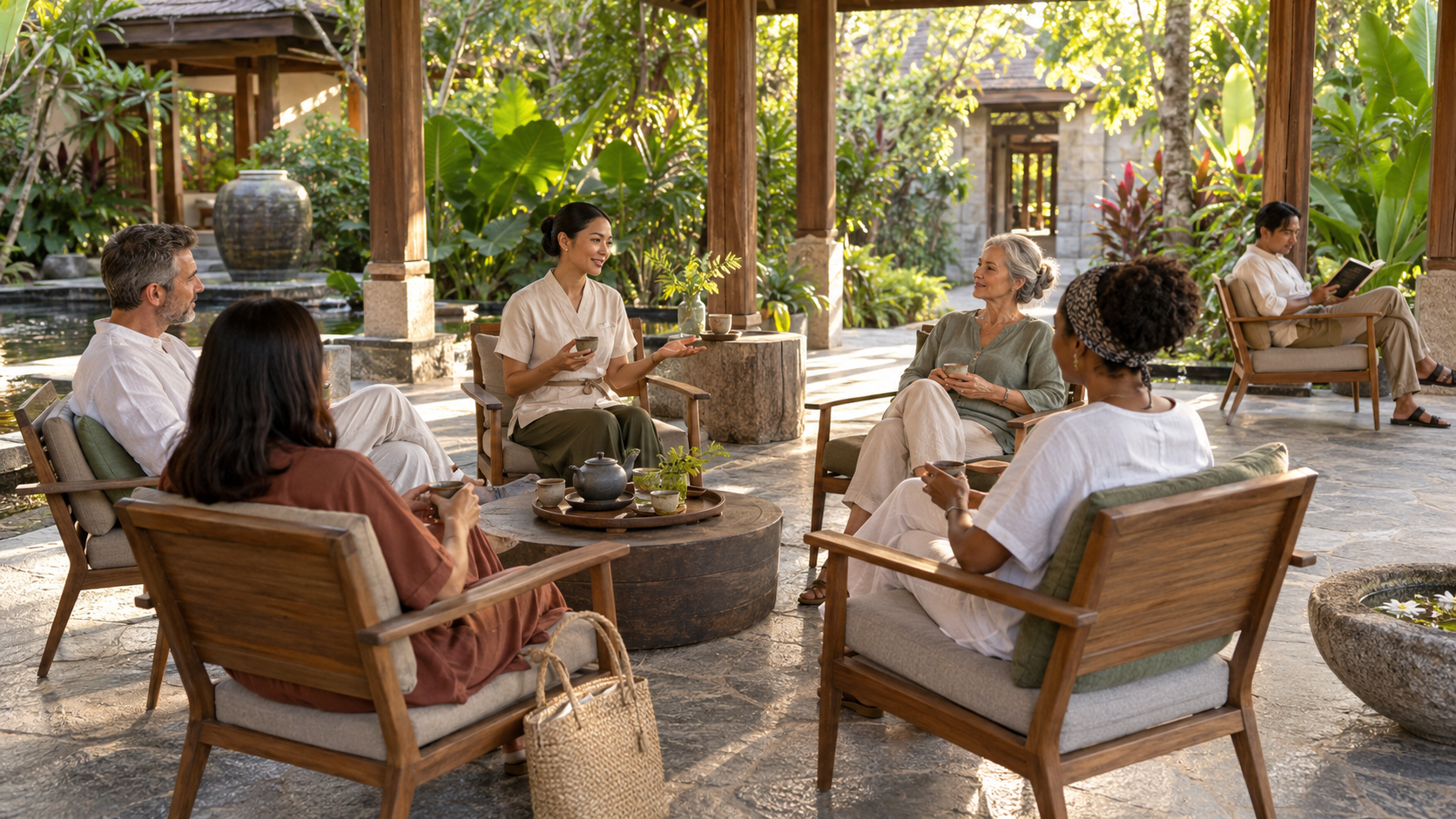
A social-wellness host needs more than a warm personality. Training should cover the exact format, timing, capacity, etiquette, accessibility, cultural context, privacy, photography, conflict response, stop conditions and escalation. The host must know when to invite conversation, when to allow silence and when to intervene.
Useful rehearsal scenarios include a guest who dominates discussion, a couple who speaks loudly in a mixed quiet zone, a participant who becomes tearful, a guest who photographs others, a language mismatch and someone who leaves mid-session. The aim is not to script every sentence. It is to give staff boundaries and options before a live situation becomes uncomfortable.
Hosts should never pressure guests to share personal histories, interpret an emotional response, promise mental-health outcomes or present temporary group warmth as evidence that loneliness has been treated. If a guest discloses immediate distress or asks for clinical advice, staff need a documented escalation path appropriate to the property and country.
Employee conditions are part of the standard. Schedule preparation and decompression time for facilitators, set realistic group limits and create a short debrief route after difficult interactions. Two-way review, as described in the site's guide to spa team evaluations, helps distinguish an individual coaching need from a broken format, unclear policy or understaffed shift.
Protect privacy, culture and access
Connection is culturally specific. Eye contact, silence, mixed-gender bathing, conversation with strangers, clothing, touch and public emotional expression carry different meanings. A global trend report cannot decide what is appropriate for one Thai property or one guest group. Work with local practitioners and communities when using cultural rituals, and do not detach a tradition from its context merely because it looks communal.
Collect only the information needed to operate the experience. Do not label a guest as lonely, shy or socially anxious in a profile. Preference data can be practical—quiet seat requested, partner booking, language support, no photography—without becoming a psychological record.
Accessibility should include mobility, hearing, vision, sensory load, language and communication style. Offer written instructions, clear lighting for lip reading, seats with arms and backs, multiple ways to participate, and a quieter equivalent where feasible. Avoid treating the accessible version as an inferior substitute or a last-minute exception.
Measure whether the format is working
A pilot should answer operational questions before it supports expansion. Start with a small number of sessions, defined capacity and a review date. Record bookings, attendance, cancellations, late arrivals, opt-ins, opt-outs, staffing time, room reset time, incidents and requested accommodations.
Ask guests separate questions: Was the social format explained before booking? Did you feel free to participate at your preferred level? Were privacy and photography rules clear? Did the host make the activity easy to understand? Was the space comfortable for both interaction and quiet? Would you choose the same format again?
Do not use a single “felt connected” score as proof of health benefit. A better dashboard combines choice clarity, comfort, complaint themes, host observations, repeat demand and commercial contribution. Compare the guided format with the solo and shared lanes rather than assuming more interaction is better.
Review comments for exclusion signals. Guests who leave early, avoid a facility or decline to answer may reveal more than the most enthusiastic participants. Staff feedback should be considered alongside guest feedback, particularly when a format creates emotional labour or disrupts surrounding quiet services.
The existing bathhouse benchmarks guide can support capacity and operating measurement where a social-wellness concept uses thermal facilities. This article addresses a different layer: whether the participation model remains voluntary, understandable and well hosted.
An eight-week pilot sequence
Weeks 1–2: define the promise and boundaries
Choose one experience, one audience and one clear description. Map the solo, shared and guided choices. Write the privacy, photography, participation and escalation rules. Check the concept against cultural and accessibility needs.
Weeks 3–4: prepare the space and team
Test seating, acoustics, entry, exits and quiet alternatives. Train at least two hosts and the reception team. Rehearse common scenarios and confirm how incidents or sensitive disclosures are handled.
Weeks 5–8: run a controlled pilot
Limit capacity and collect structured feedback after each session. Review opt-out ease, guest understanding, host workload and disruption to other services. Adjust the format before adding dates, paid media or new sites.
At review: scale only the parts guests can choose
Continue, adapt, pause or stop based on evidence. Retain a credible solo option even if the guided format performs well. Social wellness should increase the number of comfortable ways to use the spa, not narrow them.
Conclusion: belonging starts with permission
Social wellness can add meaningful warmth to spa and hospitality experiences, especially when travel, water, ritual and human hosting come together. Its quality, however, is not measured by how many strangers talk or how emotional a session becomes.
A strong programme makes the invitation clear and the exit easy. It supports solo guests as carefully as groups, trains hosts to protect boundaries, treats culture and accessibility as design inputs, and measures comfort without turning hospitality into healthcare. Connection then becomes a genuine option—never a performance guests are required to give.
Practical quality check for Social Wellness in Spas: Connection Without Pressure
People topics only matter when they change daily behavior. For this article, the test is simple: can a spa owner read "Social Wellness in Spas: Connection Without Pressure" and know what to check, what to improve and what result should change in the business? If the answer is vague, the topic needs to be translated into a concrete operating decision, not left as a broad marketing idea.
Use this topic as a short management review. Compare the current guest journey with the promise in the title, then look for gaps in training records, service observations, therapist confidence and guest feedback. The strongest version of the article is the one that connects the idea to real rooms, real staff behavior, real booking steps and real follow-up after the visit.
Owner checklist
- Define the decision: write what the owner, manager or front desk should change after reading about Social Wellness in Spas: Connection Without Pressure.
- Check the evidence: collect the page, listing, menu, script, photo, review or operating report that proves the current situation.
- Protect the guest experience: make sure the change improves clarity, comfort, trust, timing or consistency for the client.
- Choose one measure: review qualified enquiries, confirmed bookings, response time and review quality so the team can tell whether the improvement worked.
How NUAD SPA would apply it
NUAD SPA would treat Social Wellness in Spas: Connection Without Pressure as a focused workstream, not an isolated article topic. The first step is to map the current process, then decide whether the main blocker is positioning, service design, team execution, digital visibility, booking friction or retention. That diagnosis keeps the recommendation close to the title and avoids generic advice.
The next step is a two-week action sprint: update one public-facing touchpoint, brief the team on the new standard, test the booking or service flow, and collect feedback from staff and guests. This makes the article useful because it creates a next move, not only a point of view.
Risks to avoid
The common mistake is to make Social Wellness in Spas: Connection Without Pressure sound bigger than the spa can operationally support. A campaign can create demand the reception cannot answer; a new treatment can promise benefits the team has not been trained to deliver; a design trend can look attractive but reduce flow or profitability. The safer approach is to pair every idea with an owner, a checklist and a visible standard.
Frequently asked questions
What does social wellness mean in a spa?
It means offering well-designed opportunities for shared wellbeing, such as hosted tea, gentle movement, thermal orientation or quiet group ritual, while preserving privacy and solo choice.
Should every spa add communal wellness programming?
No. Demand, culture, space, staffing and guest expectations differ. Pilot one defined format and keep a credible solo alternative before deciding whether communal programming belongs in the offer.
How can a spa make social participation feel voluntary?
Explain the format before booking, offer solo, shared and guided choices, use neutral opt-out language, avoid asking guests to justify preferences and maintain an easy route away from the activity.
Can a spa claim that social wellness treats loneliness?
No. A spa can accurately describe opportunities for interaction, shared ritual and hospitality support, but it should not promise to prevent or treat loneliness, anxiety or another health condition.
What should operators measure during a social-wellness pilot?
Track description accuracy, opt-in and opt-out ease, comfort, privacy issues, accessibility requests, incidents, host workload, repeat demand, capacity and commercial contribution without presenting them as clinical outcomes.
Sources and references
- World Health Organization — From loneliness to social connection: report of the WHO Commission on Social Connection, 30 June 2025.
- Hilton — The Great Rebalance: 2027 Trends Report, 29 September 2026.
- EHL Hospitality Business School — Psychological Well-being in Hospitality Report, 30 September 2026.
- Global Wellness Institute — Early 2026 bathhouse and thermal wellness survey findings, 7 October 2026.
- Accor — Experiential Travel Trends 2026, 14 January 2026.
Need to turn this diagnosis into an action plan? Talk to NUAD SPA.