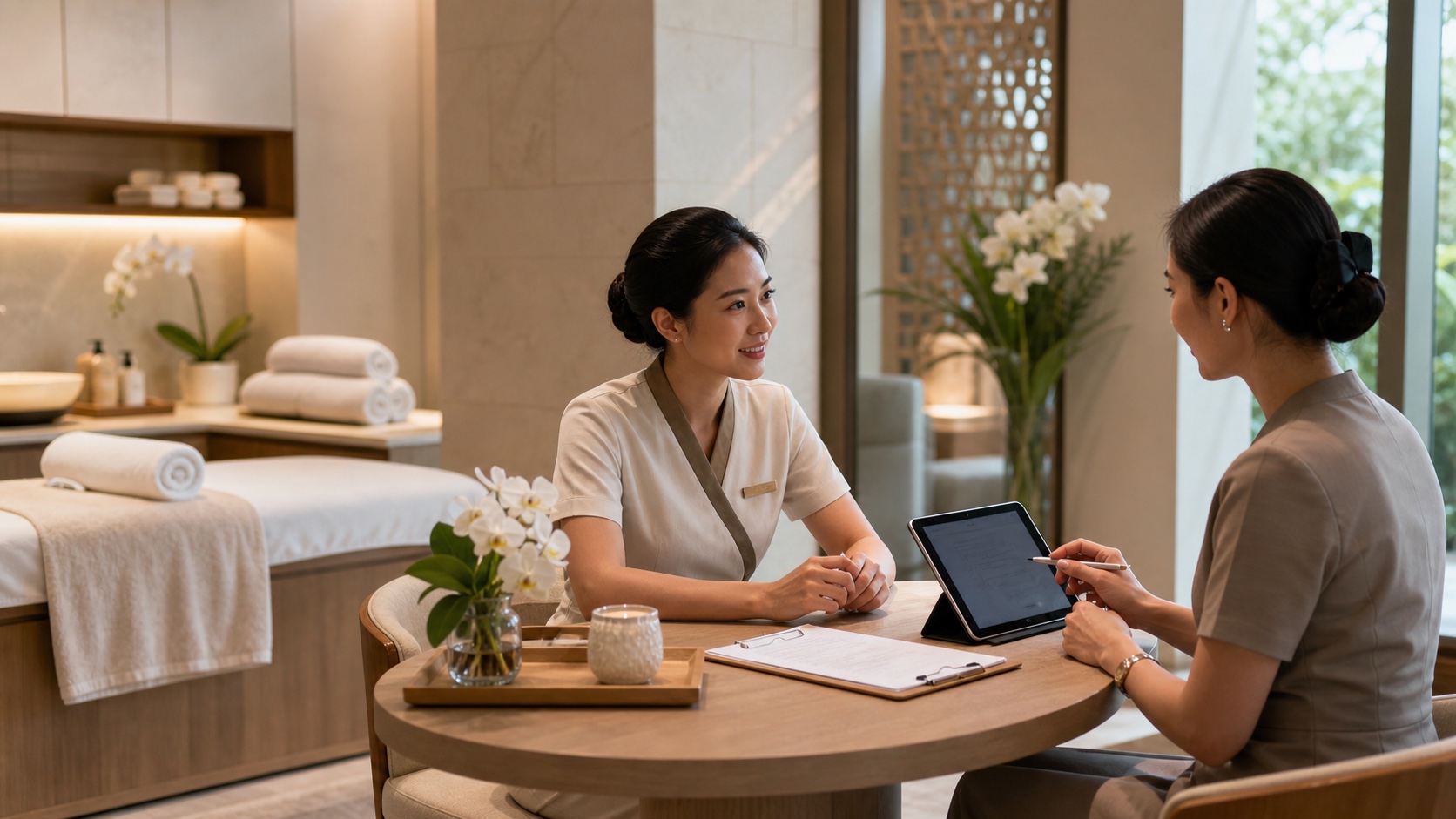
Spa evaluations are often treated as an administrative task: a form, a rating, a brief meeting and a signature. In a serious spa operation, they should be much more than that. A well-designed evaluation system is the quiet engine behind consistent treatments, confident therapists, better guest reviews, stronger retention and a culture where people know how to grow. The infographic below presents a simple but powerful idea: evaluations should not move in only one direction. Managers must evaluate and support employees, and employees must also be able to evaluate the company, its leadership, its training culture and its operating systems.
Key takeaways
- Two-way evaluation turns performance review into a shared improvement system, not a one-sided judgment.
- The most useful spa evaluations combine technical competence, service attitude, teamwork, professionalism, guest feedback and growth goals.
- Employee-to-company feedback helps owners discover problems in scheduling, tools, training, communication and culture before they damage the guest experience.
- Self-evaluation, manager review, 360-degree leadership feedback, guest audits and exit interviews each answer a different management question.
- The real value appears after the meeting, when feedback becomes coaching, training, recognition, corrected standards and follow-up.

Why evaluations matter more in a spa than in many businesses
A spa sells trust through human touch. The guest does not only buy a massage, a facial or a body ritual. The guest buys safety, listening, discretion, technique, cleanliness, timing, atmosphere and emotional ease. Most of those qualities are delivered by people in real time. That is why evaluation in a spa cannot be limited to sales numbers or attendance. It must look at the complete service behavior that makes the guest feel cared for.
In a restaurant, a guest can often see the product before judging the server. In a spa, the service is intimate and partly invisible. A therapist may be technically excellent but weak in consultation. Another may have beautiful etiquette but inconsistent pressure control. A receptionist may convert enquiries well but fail to pass important client notes to the treatment room. A manager may be organized with numbers but unclear with feedback. These small gaps become visible in reviews, repeat booking, staff turnover and the feeling of the room.
Evaluations create a formal space to identify these gaps without waiting for a crisis. They also protect the best employees. High performers need recognition, development and career direction. Without it, they may feel invisible. Newer employees need clear standards and coaching. Without it, they may guess what the brand expects. Managers need upward feedback. Without it, they may assume the system is working while the team quietly adapts around broken tools, confusing SOPs or unrealistic scheduling.
The two-way model: manager to employee and employee to company
The infographic is built around a simple loop: manager to employee, employee to company and continuous improvement in the middle. This loop is important because spa quality is not created by one heroic therapist. It is created by a system. The manager gives feedback on performance, service quality, professionalism and development. The employee gives feedback on leadership, communication, work environment, training, recognition and resources. When both sides speak honestly, the spa can improve the person and the system at the same time.
A one-way evaluation often produces defensive behavior. The employee waits to be scored. The manager tries to be fair but may focus on recent events or personal impressions. The conversation ends with a rating instead of a plan. A two-way evaluation changes the tone. The manager still has responsibility for standards, but the employee is invited to think, reflect and contribute. The question becomes: what do we need to improve so guests receive better care and the team can perform with confidence?
This does not mean every opinion becomes a decision. A spa still needs leadership, discipline and clear standards. But employee feedback is operational intelligence. Therapists know when treatment timing is unrealistic. Receptionists know which package descriptions confuse clients. Housekeeping or attendants know when room reset standards are difficult to maintain. Senior staff know which new hires need more coaching. If management never asks, the business loses information that is already inside the team.

What managers should evaluate
Manager-to-employee evaluation should begin with performance and goals, but it should not end there. In a spa, performance is not only revenue or number of treatments. It includes punctuality, preparation, treatment quality, consultation, guest comfort, product knowledge, hygiene, teamwork, communication and the ability to learn. The best evaluation forms use categories that match the brand promise. A luxury spa, a wellness retreat, a medical spa and a high-volume massage center should not use exactly the same weighting.
Technical competence is the foundation. For therapists, this includes mastery of protocols, pressure control, contraindication awareness, body mechanics, skin or body analysis when relevant, safe use of tools and consistency across different guest needs. A manager should not rely only on guest reviews because guests may not know whether a technique was technically correct. Observation, trainer feedback and treatment audits are essential.
Guest service excellence is the second pillar. Does the employee welcome the guest with warmth? Does the consultation feel natural? Are preferences recorded? Is modesty protected? Is timing controlled? Does the therapist check comfort without interrupting relaxation? Does the receptionist explain options clearly and avoid pressure? Does the team handle complaints with calm professionalism? These behaviors create the emotional memory of the spa.
Professionalism and attitude are equally important. A spa team works close to guests and close to each other. Punctuality, appearance, ethics, confidentiality, accountability and respect are not soft details. They are trust signals. A technically strong employee who spreads negativity or ignores standards can damage the culture. At the same time, a positive employee who lacks skills needs training, not vague praise. Evaluations must separate attitude, skill and results so the action plan is precise.
What employees should evaluate about the company
Employee-to-company feedback is where many spa owners discover the root cause of performance problems. If therapists are late because schedules are unrealistic, scoring punctuality alone will not fix the issue. If consultations are weak because the intake form is confusing, blaming the therapist will not improve the guest journey. If staff do not upsell because the menu is unclear or incentives feel unfair, the solution is not another motivational speech. The company must be evaluated too.
Ask employees about leadership and management. Do managers give clear instructions? Do they correct problems early or only after guests complain? Do they recognize good work? Do they explain business priorities in a way the team can understand? Do supervisors model the standards they expect? Leadership feedback can be uncomfortable, but it is one of the fastest ways to improve team trust.
Ask about communication. Spa operations depend on handoffs: booking notes, health information, room status, product availability, timing changes, guest preferences and complaint history. If one handoff fails, the guest feels disorder. Employees often know exactly where communication breaks. The evaluation process should invite them to name friction points without fear.
Ask about resources and tools. A therapist cannot deliver a five-star service with missing towels, weak lighting, poor equipment, late laundry or products that are hard to find. A receptionist cannot sell confidently if service descriptions, prices and package rules keep changing. Evaluations should ask whether staff have the tools, training and environment required to meet the standard.

The main types of evaluation and when to use them
Employee self-evaluation is useful before any formal review. It asks the employee to reflect on strengths, challenges, guest feedback, training needs and goals. This encourages ownership. It also shows whether the employee understands the standard. A self-evaluation should not be a trap. It should prepare a better conversation.
Employee-to-manager feedback focuses on leadership, support and communication. In small spas, this can be done through structured questions and a calm one-to-one conversation. In larger teams, anonymous pulse surveys may be safer. The goal is not to attack a manager. The goal is to see whether leadership behavior helps the team deliver the guest promise.
360-degree leadership evaluation gathers feedback from several directions: direct reports, peers, senior leaders and sometimes partner departments. It is especially useful for spa managers, head therapists, trainers and reception supervisors. A manager may think they communicate clearly, while therapists experience last-minute changes and unclear priorities. A 360 view reveals the difference between intention and impact.
Performance review measures results, competencies and contribution. This is the classic evaluation, but it should be adapted to spa reality. Use a mix of measurable indicators and observed behaviors: guest satisfaction, rebooking, punctuality, treatment consistency, retail or package contribution where appropriate, hygiene compliance, team support and learning progress.
Guest feedback and audits add the client perspective. Reviews, post-treatment surveys, mystery guest visits and room audits highlight strengths and opportunities. Guest feedback should not be used mechanically because one review can be emotional or incomplete. But patterns are powerful. If several guests mention rushed consultation, inconsistent pressure or poor follow-up, the evaluation system must respond.
Exit interviews help the company learn from people who leave. A spa that loses good therapists should ask why. Was compensation the issue? Scheduling? Management? Lack of growth? Conflict? Burnout? Better opportunity? Exit interviews are not only HR paperwork. They are a retention diagnostic.
From feedback to development: the moment most spas miss
The evaluation meeting is not the finish line. It is the beginning of improvement. After the conversation, each employee should leave with a small number of clear priorities: one strength to keep building, one behavior to improve, one skill to train and one measurable follow-up. Too many goals create confusion. Three or four focused commitments are usually stronger than a long list.
Development should be practical. If the issue is consultation, the action may be role-play with a senior therapist, a revised intake script and observation after two weeks. If the issue is teamwork, the action may be a handoff checklist and manager check-ins. If the issue is technical consistency, the action may be protocol retraining and a supervised treatment audit. If the issue is confidence in product recommendation, the action may be product knowledge coaching and a simple recommendation framework.
Recognition should be just as specific as correction. Instead of saying "good job," name the behavior: "Your consultation notes helped the second therapist deliver exactly what the guest needed," or "You handled the late-arrival complaint calmly and protected the schedule." Specific recognition teaches the culture what excellence looks like.
A practical evaluation rhythm for spa owners
A strong spa does not need a heavy corporate HR machine. It needs rhythm. Use daily observations for small corrections, weekly team briefings for service priorities, monthly one-to-one check-ins for coaching and quarterly formal evaluations for goals, performance and development. Add guest feedback review every month and a deeper leadership or 360 review twice a year for managers.
Before each formal review, gather evidence: attendance, guest comments, treatment audits, trainer notes, sales or rebooking data where relevant, complaint records, peer feedback and the employee self-evaluation. Then begin the meeting with the shared purpose: better people, better service, stronger results. This framing matters. Employees should feel that evaluation is about growth and excellence, not punishment.
Use a simple scoring scale, but do not let numbers replace judgment. A score can show direction, but the explanation creates learning. For every low or high score, write the behavior behind it. End with a short action plan, a date for follow-up and the support the company will provide. If the company needs to fix tools, scheduling, training or communication, write that down too. Two-way evaluation only works when management also accepts commitments.

Fairness, consistency and trust
Evaluations can motivate a team, but only if they are perceived as fair. Fairness begins with clear standards. Every employee should know what service excellence, technical competence, professionalism and teamwork mean in observable behavior. If the standard lives only in the manager's head, evaluations will feel personal. If the standard is written, trained and demonstrated, feedback becomes easier to accept.
Consistency also matters. Do not evaluate one therapist by revenue, another by personality and another by guest reviews. Different roles can have different criteria, but the logic must be transparent. Use examples, not rumors. Avoid judging only the last incident. Ask the employee for context. Check whether the company contributed to the problem. Then decide what must change.
Listening with openness is one of the best practices highlighted in the infographic. This does not mean agreeing with everything. It means staying curious long enough to understand what the employee is really saying. Many operational issues first appear as complaints. A manager who listens carefully can translate complaint into process improvement. "The room is never ready" may mean linen par levels are wrong. "Clients ask the same questions" may mean the menu is unclear. "I do not feel supported" may mean feedback only happens when something goes wrong.
Common mistakes to avoid
The first mistake is evaluating only once a year. Spa service changes every day. New guests, new staff, new packages, seasonal demand and operational pressure make annual feedback too slow. The second mistake is focusing only on weakness. A good evaluation identifies what the employee does well and how the spa can use that strength for mentoring, training or career growth.
The third mistake is using guest feedback without context. A single guest review should be considered, not worshipped. Look for patterns and compare them with observation. The fourth mistake is promising development without scheduling it. If a review says "needs more training" but no training date, trainer or topic is assigned, the process loses credibility.
The fifth mistake is ignoring employee-to-company feedback. If several employees mention unclear communication, weak tools or inconsistent leadership, the owner should treat that as business data. A spa that asks for feedback and then does nothing teaches the team to stop speaking honestly.
The business impact of a real evaluation culture
When evaluations are done well, the business impact is visible. Guest satisfaction improves because service behaviors become clearer and more consistent. Loyalty improves because returning guests meet a team that remembers standards and preferences. Retention improves because employees see a future, receive recognition and understand how to grow. Training becomes more efficient because managers know which skills are actually missing. Leadership improves because managers receive feedback before frustration becomes turnover.
For spa owners, the most valuable change is clarity. You stop managing through impressions and start managing through evidence, conversation and follow-up. You can see who is ready for promotion, who needs coaching, which standards are unclear and which operating problems block performance. Evaluation becomes a management system, not a form.
The message of the infographic is therefore simple: grow people, elevate experiences, achieve excellence. In a spa, those three ideas are inseparable. Better people create better guest experiences. Better guest experiences create stronger results. Stronger results give the business more capacity to invest in people. That is the loop every serious spa should build.
Frequently asked questions
How often should a spa evaluate employees?
Use informal feedback every week, one-to-one coaching every month and formal evaluations every quarter. Leadership feedback and 360 reviews can happen twice a year, supported by guest feedback and operational audits.
What should be included in a therapist evaluation?
Include technical competence, guest consultation, hygiene, punctuality, room preparation, pressure adaptation, professionalism, teamwork, product knowledge, guest feedback and development goals.
Should employee feedback about managers be anonymous?
For small teams, a trusted one-to-one conversation may work. For larger teams or sensitive cultures, anonymous surveys can produce more honest signals. The important point is to protect psychological safety and act on repeated themes.
How does NUAD SPA help with evaluation systems?
NUAD SPA can help spa owners connect evaluation criteria with SOPs, staff training, guest experience standards, manager coaching and operational follow-up. The goal is not paperwork. The goal is a team that knows how to improve.
Need to build a fair evaluation and staff development system for your spa? Talk to NUAD SPA.