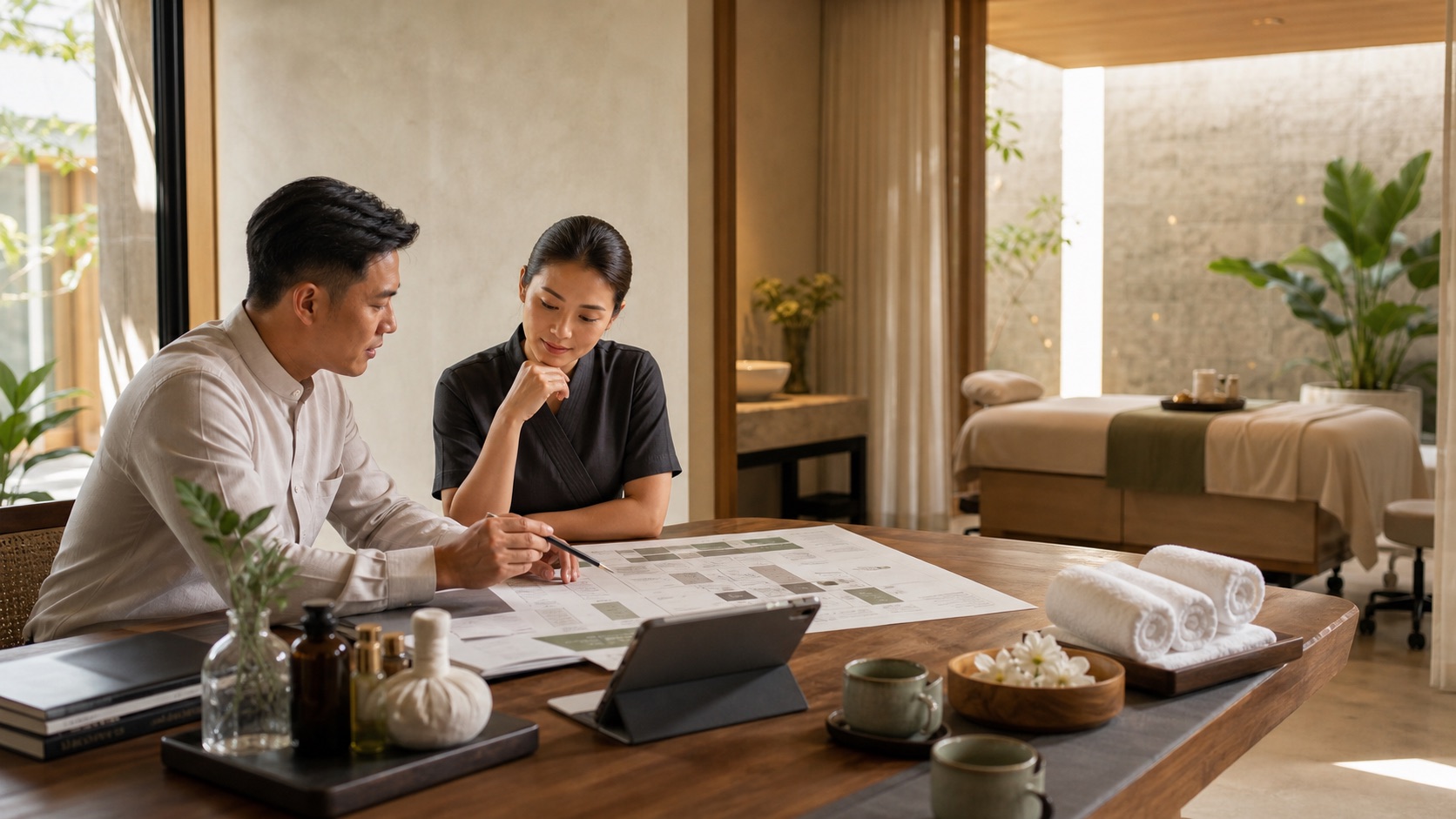
A successful spa is not built from one beautiful room, one strong campaign or one popular treatment. It is built in layers. The infographic below organizes those layers into a practical business framework: strategic foundations, guest experience planning, and experience delivery with growth. When these layers are designed together, the spa becomes easier to understand, easier to manage and harder for competitors to copy.

Key takeaways
- Spa excellence begins with strategy before marketing: audience research, market analysis, competitor review, positioning, service differentiation, pricing and a clear brand narrative.
- The guest experience plan turns strategy into a real visit: signature treatments, booking flow, therapist standards, ambience, retail, memberships, technology and journey design.
- Growth becomes more reliable when delivery is measured through reviews, feedback loops, local search visibility, loyalty, partnerships, content and continuous optimization.
- The strongest spas connect every layer. A premium promise should appear in the menu, room design, therapist behavior, content, follow-up, reviews and retention system.
How to read the Layers of Spa Excellence
The infographic is useful because it refuses a common shortcut. Many owners try to fix a spa by adding more promotion, posting more often or redesigning a logo. Those actions can help, but they are not the foundation. If the market is unclear, the service menu is generic, the booking journey is confusing or the therapist standards are inconsistent, extra marketing often amplifies weakness instead of solving it.
Think of the model as three circles that protect one another. The inner layer, strategic foundations, answers the business question: what should this spa be, for whom, at what price, and why should guests choose it? The second layer, guest experience plan, answers the service question: how should that promise feel before, during and after the visit? The third layer, experience delivery and growth, answers the operating question: how do we publish, measure, improve, retain and scale the experience without diluting it?
For a new spa, the framework can guide concept development from the first feasibility conversation. For an existing spa, it can work as an audit. Walk through each element and ask: is this documented, visible, trained, measured and connected to the guest journey? If the answer is no, the spa may still have potential, but the business is relying too much on improvisation.
Layer 1: Strategic foundations
The first layer is the least glamorous and the most decisive. Before a spa invests in interiors, social media, recruitment or paid traffic, it needs a strategic foundation. That foundation does not have to be complicated, but it must be honest. Who is the target guest? What problem are they trying to solve? What alternatives do they compare? Which services create margin? Which parts of the market are crowded? Which advantages can the spa actually deliver every day?
Audience research is the first discipline. A tourist looking for a premium Thai massage after a long flight does not choose in the same way as a local executive looking for weekly recovery, a bride preparing for an event, or a hotel guest asking the concierge for a trusted facial. Each audience has different anxieties, proof needs, price tolerance, time constraints and language expectations. If the spa tries to speak to all of them with the same promise, the message becomes soft.
Market analysis comes next. A spa owner should know local demand patterns, seasonal behavior, hotel and residential catchment areas, competing price bands, treatment trends, traffic sources and the role of nearby anchors such as offices, malls, residences, hotels or wellness districts. A useful market study is not a pile of demographics. It should tell the owner what kind of concept has a realistic chance to win. NUAD SPA's Market Study work exists for exactly this reason: to connect ambition with evidence before money is spent on the wrong offer.
Competitor analysis should go beyond listing names. Study treatment menus, durations, price ladders, booking experience, photos, reviews, location signals, therapist presentation, retail offers, membership logic and how each competitor explains value. The point is not to copy them. The point is to see the white space. A spa can differentiate through technical specialization, hospitality tone, location convenience, therapist training, cultural authenticity, sensory design, retail expertise, hotel partnerships, recovery programs or a sharper signature ritual.
Brand positioning then translates that evidence into a clear choice. A spa cannot be luxury, affordable, medical, traditional, trendy, family-friendly, romantic, recovery-focused and express at the same time. Positioning means deciding what the brand will stand for, what it will not chase, and how the guest should describe it after the visit. Strong positioning saves money because it makes menu design, hiring, photography, content, pricing and partnerships more coherent.
Service differentiation is where strategy becomes tangible. If every treatment sounds like "relaxing massage" or "deep cleansing facial," the guest has no reason to remember the brand. Differentiation may appear in a signature treatment menu, a diagnostic consultation, a pressure-personalization method, a Thai heritage ritual, a results-led facial protocol, a couple journey, a post-flight recovery package or a membership built around real guest routines. The service should have a story, a standard and a reason to be booked again.
Pricing strategy must support the positioning. Many spas damage themselves by pricing emotionally: they copy the shop next door, discount too early, or add premium language without premium economics. A serious pricing model looks at treatment duration, therapist cost, room utilization, product cost, laundry, commission, rent, booking channels, seasonality and perceived value. A low price can be strategic if the model is efficient. A high price can be justified if the experience proves it. A confused price is the danger.
Problem-goal mapping and voice of guest research complete the foundation. The guest may say "I want massage," but the real goal may be sleep, relief, privacy, confidence, skin clarity, romantic time, jet-lag recovery or a trusted recommendation for a visitor. Collecting review language, reception questions, therapist notes and search queries helps the spa write offers in the guest's vocabulary. The brand narrative should then connect the spa's expertise with the client's real desired outcome.
Layer 2: The guest experience plan
Once the foundation is clear, the second layer builds the visit. This is where many beautiful concepts succeed or fail. A spa experience is not only a treatment. It is a sequence: discovery, enquiry, booking, arrival, welcome, consultation, room transition, treatment, aftercare, checkout, follow-up and return. Every stage can reassure the guest or create friction.
The signature treatment menu is one of the most powerful tools in this layer. A good menu does not overwhelm. It organizes treatments in a way that helps the guest decide. Categories should be intuitive, names should be memorable but not obscure, durations should make operational sense, and each treatment should have a clear promise. The menu should also protect therapist delivery. If the description promises deep therapeutic results but the training is generic, the gap will appear in reviews.
Guest journey design maps the emotional and operational flow. What does the guest see first online? How many steps does booking require? What message confirms the appointment? How does the reception team greet the guest? Where does the guest wait? How are preferences collected? Does the therapist receive the notes? How does the room smell, sound and feel? What does the guest hear after the treatment? Journey design turns vague hospitality into a sequence that can be trained and improved.
Therapist SOPs are the backbone of consistency. Standards should include consultation, hygiene, room setup, draping, pressure adaptation, contraindication awareness, product usage, service timing, verbal check-ins, aftercare and reset. A good SOP does not remove personality. It gives each therapist a reliable floor of excellence so the guest can trust the brand, not only one favorite employee. NUAD SPA's SOP service connects these standards with actual operations rather than leaving them inside a manual nobody opens.
The booking flow is part of the experience. A spa can lose a client before the treatment if the booking path is slow, unclear or not mobile-friendly. The guest needs to understand the service, choose a time, share important preferences, receive confirmation and know how to change the appointment if needed. For a premium spa, the booking system should also protect staff scheduling, room capacity, deposits, gift vouchers, memberships and therapist allocation.
AI and tool integration should be judged by usefulness, not novelty. Automated replies, booking recommendations, CRM segmentation, dashboard alerts, review summaries and content planning can all help a spa, but only if the underlying process is clean. A chatbot cannot fix an unclear menu. A dashboard cannot fix missing data. The best technology removes friction from a guest or team workflow that already makes sense.
Retail strategy belongs in the guest experience plan because products extend the treatment. Retail should not feel like pressure at checkout. It should feel like aftercare. The therapist and reception team should understand why a product is recommended, how it supports the treatment result and what the guest should do at home. Visual merchandising, sampling, staff training and inventory discipline all affect whether retail feels premium or random.
Memberships and packages can stabilize revenue when they are built around real behavior. A monthly massage plan, facial maintenance program, post-work recovery pass, couple ritual package or hotel guest offer should solve a repeat need. The worst membership is just a discount card. The best membership creates continuity: preferred times, remembered preferences, priority booking, seasonal upgrades, thoughtful reminders and measurable retention.
Ambience and sensory design are often treated as decoration, but they are operational tools. Lighting, music, scent, temperature, textiles, room acoustics, product presentation and therapist movement all influence perceived quality. A spa should decide what atmosphere supports its promise, then make it repeatable. If the scent is too strong, the music unreliable or the room temperature inconsistent, the brand promise weakens even when the treatment is technically good.
Layer 3: Experience delivery and growth
The third layer takes the planned experience into the market. Delivery and growth include content, visual branding, local search, reviews, publishing, promotions, optimization, feedback loops, loyalty, partnerships and wellness education. This is the layer most people call marketing, but in a strong spa it is more than promotion. It is the public proof that the operation is real.
Content and storytelling should explain the spa's value with useful specificity. A strong article, service page or social caption helps the guest make a decision. It explains what the treatment is for, who it suits, what the guest should expect, what proof supports the promise and what next step makes sense. Storytelling is not pretending the spa is magical. It is translating operational strength into language people can trust.
Visual branding must reveal the actual experience. Generic stock visuals make a spa look interchangeable. Real treatment rooms, therapist gestures, linen details, reception moments, products, consultation scenes and aftercare rituals create stronger trust. The banner created for this article follows that logic: it shows planning inside a calm spa environment, because the theme is not decoration but organized excellence.
Local search and maps matter because spa decisions are often local, urgent and comparison-based. Guests look for proximity, open hours, photos, reviews, service clarity and booking options. Google Business Profile guidance emphasizes relevance, distance and prominence as local ranking factors, which is why a spa should keep its business information accurate, maintain strong photos, earn reviews and make the service categories easy to understand. Search visibility should reflect the same positioning defined in Layer 1.
Review management is not damage control. It is a learning loop. Reviews show what guests remember, what language they use, which therapists or services stand out, and which friction points keep returning. A serious spa responds professionally, protects client privacy, thanks guests, addresses issues and turns patterns into training. If many reviews praise the same ritual, that ritual should appear in content. If guests mention confusion at arrival, the front desk process needs attention.
Social media, publishing and promotions should follow the strategy rather than chase trends. A content calendar can include treatment education, therapist expertise, room details, guest questions, package launches, seasonal wellness, partner features, before-and-after process explanations where appropriate, and behind-the-scenes operational proof. Promotions should be used carefully. Discounting can fill empty slots, but too much discounting teaches clients to wait.
Optimization connects the third layer back to the first two. Track impressions, clicks, enquiries, booking conversion, review themes, repeat visits, membership uptake, average ticket, therapist utilization and guest feedback. Then update the pages, offers, scripts, photos or SOPs according to what the data shows. A spa should not publish forever without learning. Growth is not a noise machine. It is a disciplined improvement rhythm.
Guest feedback loops are essential because the spa cannot see every experience from management's desk. Collect feedback after treatments, listen to reception questions, review therapist notes, monitor complaints and compare guest comments with operational audits. The goal is not to collect praise. The goal is to understand the small gaps between what the brand promises and what guests actually feel.
Loyalty and retention turn one good visit into a relationship. Retention depends on memory: preferred pressure, favorite therapist, skin concerns, fragrance sensitivity, birthday, travel pattern, membership status, last treatment and next recommended step. A CRM should help the team use that memory respectfully. For mobile or hotel-based services, a platform like NUAD APP shows how booking, preferences and service continuity can extend spa standards beyond the fixed location.
Partnerships can accelerate trust when they are relevant. Hotels, residences, clinics, wellness brands, tourism operators, trainers, product suppliers and respected local venues can all introduce qualified audiences. The key is alignment. A partner should reinforce the spa's standard, not dilute it. For example, Loft Thai Spa is a useful Bangkok reference for how a spa can combine recognizable local identity, professional treatment delivery and a premium guest promise.
Wellness education completes the growth layer. Educated guests book with more confidence, choose better treatments and return with clearer goals. Education can explain pressure levels, facial maintenance, post-treatment care, aromatherapy, contraindications, membership routines, skin cycles, recovery habits or how to prepare for a first visit. The more useful the education, the less the spa depends on hard selling.
How the three layers connect in practice
The layers only work when they are connected. Audience research should influence the menu. The menu should influence therapist training. Therapist training should influence content. Content should influence booking questions. Booking questions should influence the CRM. CRM patterns should influence packages. Reviews should influence SOPs. Local search should reflect the real service categories. Partnerships should reinforce the positioning.
When these connections are missing, the spa feels fragmented. The website promises luxury, the booking form feels basic, the room is beautiful but the therapist script is inconsistent, the social media looks premium but the reviews mention delays, or the membership offer exists but nobody follows up. The guest may not know the internal cause, but the experience feels less confident.
A layered spa excellence system gives management a way to diagnose the issue. If demand is weak, review Layer 1 and Layer 3: positioning, market fit, search visibility, proof and content. If reviews are mixed, review Layer 2: journey, SOPs, therapist training, ambience and booking handovers. If growth is expensive, review the connections: retention, memberships, partnerships and service differentiation.
A 90-day implementation roadmap
In the first 30 days, audit the foundation. Interview guests and reception, read reviews, compare competitors, review booking data, check margins, inspect the menu and clarify the brand position. Keep the work practical. The output should be a short decision document: target audiences, strongest services, weak points, price logic, market opportunities and one sentence that defines the spa's promise.
In days 31 to 60, redesign the guest experience plan. Rewrite the menu where needed, map the journey, fix the booking flow, document core SOPs, improve room standards, define retail recommendations, and create two or three packages that match real guest goals. Train the team on the new standards before announcing them publicly. A spa should not market a promise that the team has not rehearsed.
In days 61 to 90, strengthen delivery and growth. Refresh key service pages, update local profiles, add real photos, request reviews ethically, build a simple content calendar, launch one focused promotion, create a feedback form, set up retention reminders and define a monthly dashboard. Review the first results with both management and staff. The team should see how the changes affect the guest, not only the marketing report.
Metrics that matter for spa excellence
Good measurement is balanced. Strategic metrics include revenue by treatment, gross margin, room utilization, therapist utilization, average ticket and repeat booking rate. Guest experience metrics include review score, complaint themes, consultation completeness, waiting time, therapist request rate and satisfaction after treatment. Growth metrics include local profile actions, organic enquiries, booking conversion, content engagement, membership uptake, package sales and referrals.
A small spa does not need a complicated dashboard on day one. It needs a rhythm. Review a few numbers every week, connect them to real guest comments, choose one improvement and check whether the next week changes. Measurement should create decisions, not decorate reports.
Common mistakes to avoid
The first mistake is trying to grow before the foundation is strong. More visibility will not help if the offer is unclear or the experience is inconsistent. The second mistake is treating design as decoration rather than flow. A beautiful room that slows therapists or confuses guests is not excellent. The third mistake is copying competitors instead of understanding why guests choose them.
The fourth mistake is separating marketing from operations. In a spa, marketing publishes the promise that operations must deliver. If the two teams do not talk, the brand becomes fragile. The fifth mistake is ignoring feedback that does not fit the owner's taste. Guest comments, therapist notes and reception questions are not interruptions. They are business intelligence.
References and further reading
- ISO 17679:2016 - Tourism and related services - Wellness spa: official standard page for wellness spa service requirements and supporting processes.
- Global Wellness Institute - 2025 Global Wellness Economy Monitor: market context for the global wellness economy.
- Google Search Central - SEO Starter Guide: search fundamentals for making useful content discoverable.
- Google Business Profile Help - Improve your local ranking: official guidance on relevance, distance and prominence in local visibility.
- Google Search Central - Image SEO best practices: guidance for image context, alt text and visual discoverability.
- Schema.org - BlogPosting: structured data vocabulary used for article content.
Frequently asked questions
What is the most important layer of spa excellence?
The foundation is the most important because it shapes every later decision. Without a clear audience, position, service difference and price logic, the guest experience plan and growth system become harder to manage.
Can an existing spa use this framework?
Yes. Use it as an audit. Score each item in the infographic as clear, partly clear or missing. Then fix the layer that creates the most friction for guests or staff.
How long does it take to improve a spa using this model?
Some improvements can happen in two weeks, such as clearer menu language, better booking questions or a simple review response process. Deeper work, such as repositioning, SOPs, training and retention systems, usually needs a 60 to 90 day plan.
Does spa excellence require a large budget?
No. Budget helps, but clarity and discipline matter more. Many improvements are managerial: better handovers, cleaner standards, sharper treatment names, more useful follow-up and a stronger feedback loop.
Need to turn the Layers of Spa Excellence into a practical action plan for your spa? Talk to NUAD SPA.