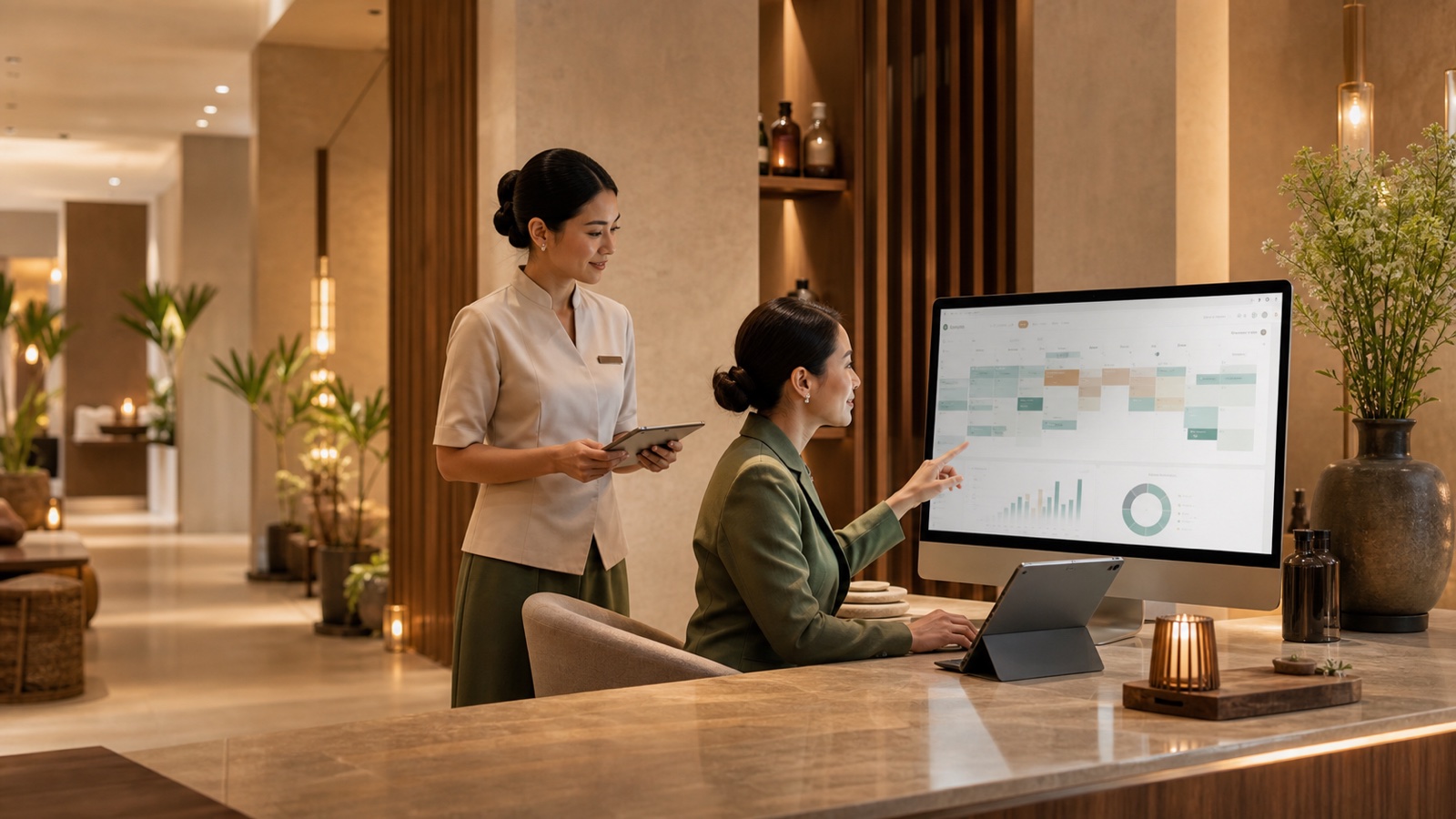
A spa booking system should no longer be a simple calendar. In a modern spa, one reservation touches the client, branch, room, service, therapist, duration, price, deposit, voucher, promo code, reminder, commission, revenue forecast and follow-up. The AI-powered booking system we propose is the result of five years of development around that reality: a back office built to turn booking data into operational control, commercial intelligence and better guest experience.
Key takeaways
- A strong spa booking platform must connect reservations with CRM, staff capacity, vouchers, promos, payments, analytics and manager decisions.
- AI is most useful when it sits above clean operational data: forecasting demand, answering business questions, prioritizing actions and assisting staff without removing human validation.
- The strongest commercial value is not only more bookings; it is fewer mistakes, faster decisions, better retention, clearer revenue and a calmer team.

Why spa booking needs a deeper system
Many spas still treat booking as an appointment slot. That view is too small. A client who books a two-hour couples massage is not only occupying a line in a calendar. The booking may require two therapists, one room or two connected rooms, a deposit, a specific branch, a voucher balance, a promo rule, a reception note, a special request, a follow-up message and a commission calculation. If any of those details are scattered across tools, the guest experience becomes fragile.
The pressure is even higher for multi-branch spas, hotel spas, premium massage concepts and wellness businesses with many services. The reception team must move fast. Managers need to see capacity. Owners need to understand revenue. Therapists need clear assignments. Marketing needs to know which campaigns create bookings that actually arrive. A normal calendar cannot answer all of that.
This is why we designed the booking system as a spa operating system. The goal is to give the team one reliable place to manage bookings, clients, staff, services, rooms, promos, vouchers, deposits, analytics and AI-assisted priorities. It is not technology for decoration. It is technology built around the daily friction of a real spa.
Five years of development: from legacy pressure to safer control
The system exists because spa operations are full of edge cases. Over five years of development, the work was not only about adding screens. It was about understanding how booking logic breaks under real pressure: wrong branch, wrong room, missing deposit, double staff requirement, terminal booking status, voucher balance confusion, promo validity, client duplicate, no-show risk, special request and last-minute calendar change.
A good system must protect the team from those errors without slowing the front desk. That is why the booking layer includes filters, editable booking records, status management, booking logs and business validation. A booking can be searched by booking number, client, branch, status, period, name, email, phone or free text. A manual booking can connect the client, branch, services, staff, room, status, voucher or promo. A booking record can hold client information, deposit, payment status, allergies, special requests, internal comments, services, rooms and therapists.
That level of detail matters commercially. Every error avoided protects the brand. Every clear booking record saves staff time. Every audit trail makes management safer. A spa does not become premium only through design and treatment quality; it becomes premium through operational reliability.
The AI layer: intelligence above real bookings
AI becomes useful only when the underlying data is structured enough to trust. The system already includes analytics and an AI agent designed around booking data. A manager can ask business questions in natural language, such as completed revenue, future pipeline, number of bookings, average ticket or branch ranking. When OpenAI is configured, the agent can classify the question and route it toward the right analysis. If the API is not available, a local fallback can still answer core intent categories. This matters because a spa tool must stay useful even when an external AI service is temporarily unavailable.
The system also includes a 14-day forecast built from secured amounts, historical weekday behavior, open potential and confidence. This is where AI and analytics become practical. If next Tuesday is weak, the manager can act before the day is lost. If the weekend is already strong, the priority may be staffing, room preparation and quality protection rather than more promotion. If deposits are at risk, the reception can focus on confirmation before the booking fails.
The next step is an AI Booking Copilot. The copilot can read a client request and prepare a booking draft: desired date, branch, service, number of people, duration, staff requirements and special notes. The team keeps final approval, but the repetitive work becomes faster. This is the right model for spa AI: assist the human, reduce friction and keep control where the business risk is real.
CRM: from reservation to client relationship
A booking system becomes much more valuable when it understands the client behind the appointment. The CRM layer stores client history, communication preferences, booking volume, completed revenue, first visit, last visit and upcoming reservations. The system can identify new clients, repeat clients, reactivated clients, dormant clients and high-value clients. This turns booking data into relationship management.
For a spa, retention often creates more profit than constant acquisition. A guest who enjoyed a facial might be ready for a package. A massage client who books every month should not receive a generic discount blast. A dormant client might need a soft winback message. A VIP should be protected when their preferred therapist is unavailable. A new client should receive a follow-up that feels helpful, not automated.
AI can make this CRM more precise. A client value score can help managers prioritize VIPs and high-potential clients. Churn prediction can highlight clients who are slipping away. A next-best-service recommendation can suggest the right add-on, upgrade or package based on service history, preferences and booking rhythm. The commercial point is simple: the spa stops treating every client the same.
Smart availability: staff, rooms, service duration and margin
Spa availability is not only open time. A slot is truly available only when the right room, therapist, service duration, branch and business rule can work together. A couples service may need two therapists. A specialist facial may require specific skills. A long massage may block a prime room. A high-margin package may deserve priority over a low-value short slot when capacity is tight.
The system already stores the operational ingredients needed for smarter scheduling: services, durations, prices, commissions, categories, staffing rules, visibility, branches, rooms and staff profiles. That prepares the ground for a Smart Availability Engine. Instead of showing every possible time, the system can propose the best times: the ones that fit real capacity, protect the guest experience and support revenue.
Therapist Matching AI is another important layer. A premium spa should not assign staff randomly when skills, language, client preference, past experience and current workload matter. The AI can recommend a therapist, but the manager or reception team remains able to override. That balance keeps the system intelligent without making it rigid.
Vouchers, promos and revenue recognition
Many booking systems become weak around vouchers and promotions. A voucher is not only a sale; it is a liability until the service is delivered. A promo is not only a discount; it is a rule that should apply to the right service, at the right time, for the right commercial reason. If these pieces are disconnected from booking, the spa can lose control of revenue.
The system connects vouchers, promos and bookings. It can track voucher type, status, face value, remaining balance, source, transactions and redeemed value. It can manage promo status, expiration, applicable days or hours, excluded services and code validation. It can distinguish paid value, active liability, paid-undelivered vouchers, expired paid value and revenue recognized through completed bookings.
This is where AI can add a strong commercial layer. Voucher Risk AI can alert managers to paid vouchers that have not been delivered, balances that look inconsistent or expirations that need action. Dynamic Promo AI can identify weak days and propose a controlled offer without damaging margin. Upsell AI can suggest a compatible add-on during booking when staff and room capacity allow it.
Marketing automation with human validation
The system maps important automation opportunities: booking reminders, deposit reminders, winback campaigns, service follow-up, lead queue, staff absence alerts, commission recaps, record expiration, forecast updates and contact cleanup. But sensitive automation should not be rushed. Email sending, cron execution and client-facing actions must have locks, logs, retries, dry-run mode and idempotence before they become fully active.
This is a commercial advantage, not a limitation. Many legacy systems become dangerous because they automate without enough visibility. A modern spa needs automation that is powerful but auditable. The right AI Campaign Builder should propose the audience, message, code promo, channel, timing and forecasted result, then allow a human to approve before sending. That protects client trust and brand tone.
For international spas, multilingual AI can help reception and marketing write in English, French, Thai, Chinese, Japanese or Russian. But the system should preserve validation. AI can draft and personalize; the team should approve language that touches the client.
Manager dashboard: the day in one view
The daily manager view is where the system becomes operational. A spa manager should not need to build a report manually every morning. The system can show today, tomorrow, the next 7 days, the next 14 days, revenue movement, average ticket, service count, incident rate, unassigned bookings and deposit risk. It can compare branches, services, sources, statuses, demand slots, monthly trends and periods.
The AI Operations Copilot can turn that into a daily brief: which slots need attention, which bookings need assignment, which deposits should be chased, which branch is behind forecast, which therapist capacity is tight, which clients should be called and which offer might fill a weak day. This is the kind of AI that managers actually need: not a chatbot for novelty, but a calm assistant that reads the operation and points to the next best actions.
Security, migration and quality gates
A booking system touches sensitive data and commercial workflows, so safety is part of the product. The system uses user roles, sessions, CSRF protection on sensitive forms, health checks, database profiles for TEST and PROD, and quality-control scripts. It also keeps email sending and cron execution disabled until the relevant controls are ready. That makes the migration safer for businesses that depend on legacy data.
This matters when replacing an old system. A spa cannot stop operating while software is modernized. The safer approach is progressive migration: keep historical compatibility where necessary, read from the real database, validate critical booking rules, protect sensitive writes, test remotely when local PHP is not enough, and only reactivate automation when it can be observed and rolled back.
For owners, this means innovation without chaos. The team gets a cleaner interface and better intelligence, while the business protects the operational history that already exists.
Implementation roadmap for a spa
- Phase 1: connect booking, calendar, client search, service catalog, staff and booking logs.
- Phase 2: activate analytics, 14-day forecast, branch comparison, source analysis and deposit-risk visibility.
- Phase 3: add AI agent questions for revenue, pipeline, average ticket, bookings and branch ranking.
- Phase 4: introduce AI copilot workflows for draft booking, smart availability, therapist matching and client segmentation.
- Phase 5: activate controlled automations: reminders, winback, campaigns, voucher risk and daily manager brief.
Why this matters commercially
The commercial promise is not only that the spa can take bookings online. The promise is that the spa can run with more clarity. Reception works faster. Managers see risk earlier. Owners understand revenue better. Marketing can target real client segments. Staff assignments become more logical. Vouchers and promos become measurable. AI turns data into priorities rather than another dashboard to ignore.
After five years of development, the value is in the integration. Booking, CRM, staff, vouchers, promos, analytics and AI are stronger together than as separate tools. A spa that wants to scale needs that shared operating spine. Without it, every branch invents its own habits. With it, the business can build standards, compare performance and improve every week.
Frequently asked questions
Does AI replace the spa reception team?
No. The best model is AI-assisted reception. The system can prepare drafts, summarize priorities, detect risks and recommend actions, but the team should confirm sensitive booking, client and campaign decisions.
Is this only for large spas?
No. A single spa can benefit from cleaner booking, CRM and forecast. Multi-branch operators gain even more because they need shared definitions, branch comparison and consistent operating controls.
Why did this require five years of development?
Spa booking looks simple from outside, but the real system has many rules: staff, rooms, service duration, deposits, promos, vouchers, legacy data, commissions, branches, status protection, client history and automation safety. Building a reliable system means solving those details carefully.
References and further reading
- Schema.org - Reservation
- Schema.org - LocalBusiness
- Google Search Central - Local business structured data
- OWASP - Cross Site Request Forgery
- OWASP Top 10
Need to turn this diagnosis into an action plan? Talk to NUAD SPA.